

Building an Executive Center in Makati

For the global decision-maker, expansion into Southeast Asia is no longer a question of “if,” but “where” and “how fast.” In the Philippines, all roads for high-tier enterprise lead to the Makati Central Business District. However, the traditional approach to office procurement—long-term leases, massive construction timelines, and complex utility management—is being replaced by a more agile strategy.
Establishing an Executive Center in Makati has evolved from a convenience into a strategic imperative. It represents the shift from owning “dead” real estate to utilizing a “living” business platform. For companies with roots in Japan, Australia, or Europe, this model provides the necessary cultural and operational bridge to navigate a new market without the typical friction of foreign expansion.
THE EPHEMERAL ADDRESS VS. THE STRATEGIC ASSET
In corporate real estate, we often distinguish between an “Ephemeral Address”—a temporary, low-cost space that offers little more than a desk—and a “Strategic Asset”—a location that actively contributes to your company’s valuation, talent retention, and brand prestige. When we speak of Foreign Direct Investment (FDI), we refer to the capital flux from your home base into the Philippines; your office is the physical vessel that protects that investment.
The Wall Street of the Philippines
Makati is not merely a neighborhood; it is a financial ecosystem. Establishing an Executive Center in Makati places your brand at the undisputed epicenter of Philippine finance and governance. Much like Marunouchi in Tokyo or the City of London, a Makati address acts as an immediate “trust signal” to local banks, regulators, and partners. For a multinational company, this location serves as a gateway, providing the proximity required to close deals in the boardrooms of Ayala Avenue rather than losing hours in the city’s notorious traffic.
The Gateway for Multinational Enterprise
The district remains the primary choice for FDI because of its density. Within a few square kilometers, you have the highest concentration of “Grade A” buildings—structures that meet international standards for safety, technology, and aesthetics. For decision-makers overseeing operations ranging from lean startups to 50-man specialized teams, Makati offers a foundational pillar. It allows a firm to remain “lean” while appearing “large,” leveraging the district’s prestige to compete with much larger established entities.
The Agility Mandate
The modern global economy moves faster than a five-year lease. The “Agility Mandate” is the growing requirement for companies to be able to scale their headcount up or down in response to market shifts. By choosing a high-tier, fully supported hub over a traditional “bare shell” (an empty concrete space), you trade the headaches of property management for operational velocity. You aren’t just renting an office; you are securing a turnkey environment where the infrastructure is already optimized for global ambitions, allowing your leadership to focus on market share rather than floor plans.
WORLD-CLASS INFRASTRUCTURE AND BUSINESS CONTINUITY
For an executive overseeing global operations, “infrastructure” is the invisible foundation that keeps a business solvent. In the context of the Philippines, two critical terms often arise in technical briefings: N+1 Redundancy and The Flight-to-Quality.
N+1 Redundancy is a configuration where the components (like power generators or internet lines) have at least one independent backup to ensure that if a primary system fails, the “plus one” takes over immediately without a lapse in service. Flight-to-Quality refers to a global market trend where discerning companies move away from older, cheaper buildings and migrate toward “Prime” or “Grade A” assets that offer superior safety and technology.
Always-On Operations: Power Resilience
In a developing market, power stability is often the primary concern for Japanese and Western investors. A premier Executive Center in Makati solves this by occupying buildings equipped with 100% power redundancy. This means that during a city-wide utility failure, the center’s N+1 generator systems activate instantly, supporting not just the emergency lights, but every single workstation, server, and air-conditioning unit. For a multinational company, this ensures that a “local” power issue never becomes a “global” service interruption.
Enterprise-Grade Connectivity: The Digital Lifeline
Connectivity is the pulse of a modern hub. When managing teams that report to headquarters in London, New York, or Sydney, consumer-grade internet is insufficient. High-tier centers provide access to a fiber-optic ecosystem with symmetrical speeds (equal upload and download) and multiple “failover” paths.
By utilizing diverse telecommunications carriers, these centers ensure that if one provider experiences a cable cut, the system automatically reroutes traffic to a secondary provider. This “failover-ready” architecture supports high-frequency trading, seamless video conferencing, and heavy cloud-data transfers that 30-to-50-man teams require to remain competitive.
Sustainability as a Corporate Standard (ESG)
For decision-makers from Europe and Australia, Environmental, Social, and Governance (ESG) mandates are often legally or board-mandated. Establishing an executive presence in a building that is LEED Gold (Leadership in Energy and Environmental Design) or WELL-certified is no longer just about “being green.”
These certifications ensure that the building uses advanced air filtration systems to improve cognitive function and high-efficiency lighting to reduce carbon footprints. By choosing an office that adheres to these global standards, leadership ensures that the Philippine branch remains compliant with the parent company’s global sustainability audits, while simultaneously providing a workspace that attracts high-caliber talent who value their physical well-being.
THE STRATEGIC ADVANTAGE OF PROXIMITY
In high-stakes business, we often discuss the “Agglomeration Effect.” This is a phenomenon where companies in the same industry cluster together to reduce “transactional friction”—the time, cost, and effort required to do business. When you establish an Executive Center in Makati, you are positioning your firm within a High-Density Professional Ecosystem. This term refers to an environment where every ancillary service your business needs (legal, financial, and logistical) is located within a walkable “micro-radius,” typically defined as a five-to-ten-minute journey from your desk.
The Institutional Core: A Circle of Trust
Makati remains the undisputed gravity well for the Philippine financial sector. For a decision-maker, proximity to the “Institutional Core” means your finance team is minutes away from the headquarters of BDO, BPI, and Metropolitan Bank, as well as international giants like HSBC and Citibank.
This proximity is not just about convenience; it is about visibility. Being physically present in the same district as the Philippine Stock Exchange and the country’s major regulatory bodies fosters a “circle of trust” that is difficult to replicate in emerging satellites. For companies based in Japan or the UK, where face-to-face rapport is a cornerstone of corporate culture, this immediate access accelerates the pace of local banking and compliance approvals.
Unrivaled Professional Ecosystem: Hospitality and Logistics
An executive center is often judged by what lies outside its front door. The Makati CBD is designed for the “Global Nomad”—the executive who may be flying in from Singapore or Sydney for a quarterly review.
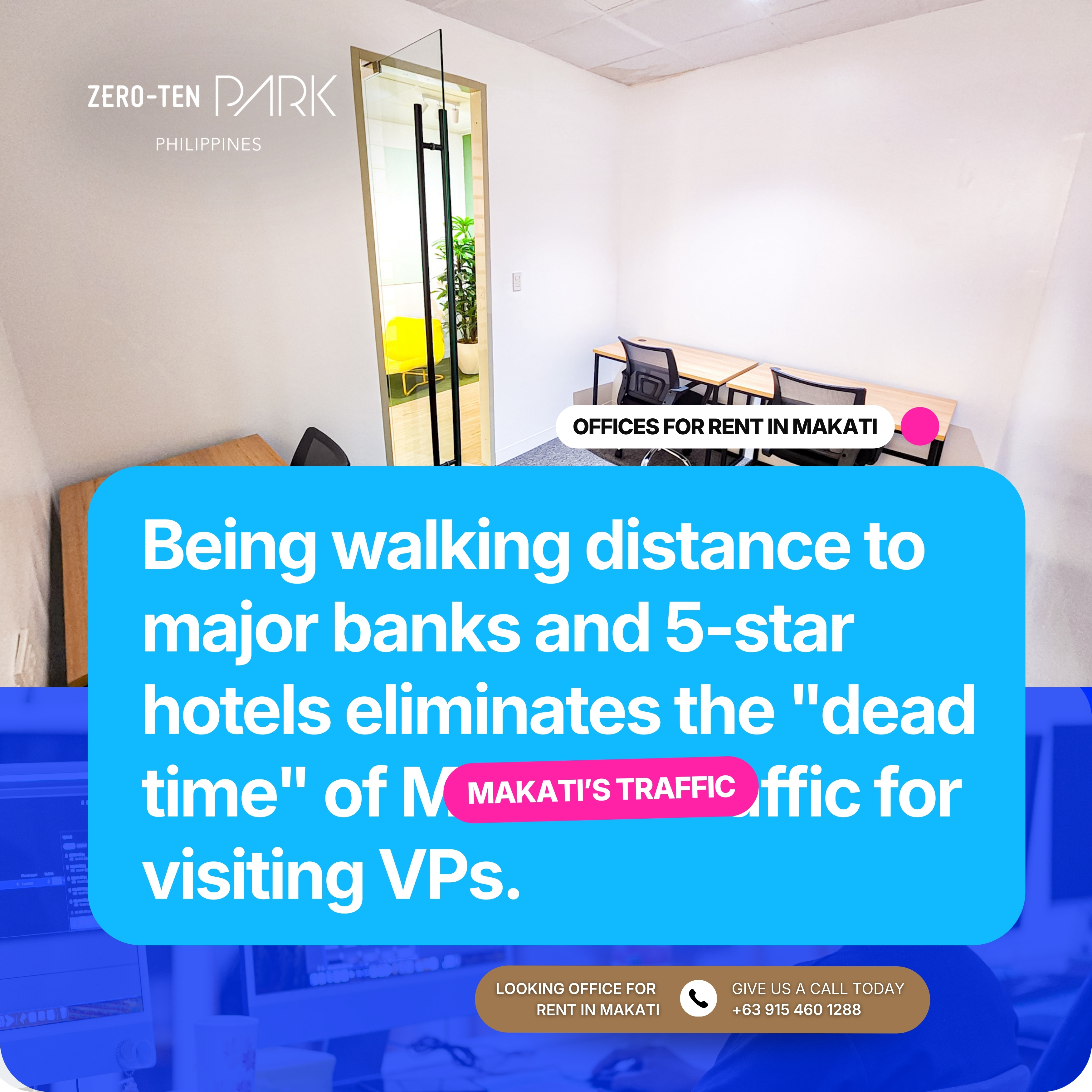
The district offers a seamless transition from the boardroom to the “Third Space.” High-end lifestyle hubs like Greenbelt and Glorietta provide world-class dining and retail, while five-star hospitality brands like The Peninsula, Raffles, and Fairmont ensure that international clients and visiting partners are accommodated in a manner consistent with your brand’s prestige. This proximity eliminates the logistical “dead time” often found in less developed business hubs, ensuring every hour of a business trip is optimized for productivity.
Access to Elite Talent: The “Quality of Life” Magnet
For your 30-to-50-man teams, the choice of location is a primary factor in recruitment and retention. Makati acts as a talent magnet because of its accessibility. It sits at the intersection of major transport arteries (EDSA and the Skyway), making it the most reachable destination for the country’s “Elite Talent Pool”—the highly educated, multilingual professionals in finance, legal, and IT.
Positioning your office here ensures that you are not just hiring employees, but attracting professionals who value the walkability and safety of the district. By placing your team in a premier environment, you reduce the “churn rate” (the frequency at which employees leave) by offering them a workplace that reflects their own professional caliber.
FINANCIAL FORENSICS: DEEP CONSIDERATIONS FOR DECISION-MAKERS
In commercial real estate, looking at the “monthly rent” is equivalent to looking at the tip of an iceberg. To protect your bottom line, you must perform Financial Forensics—a granular audit of the total cost of occupation.
Two critical terms you will encounter are CAPEX (Capital Expenditure) and OPEX (Operating Expenditure). CAPEX refers to the massive, one-time upfront investment required to build out a space (furniture, wiring, partitions), while OPEX refers to the ongoing monthly costs of running that space. We also look at the TOC (Total Occupancy Cost), which sums up rent, taxes, utilities, and maintenance to reveal the true monthly “burn rate” of your office.
The CAPEX Trap: The Hidden Cost of “Bare Shell”
For many startups and mid-sized teams, the “Bare Shell” model—a raw concrete space with no lights, floors, or air-conditioning—is a significant financial trap. In Makati, fitting out a bare space to international executive standards can cost anywhere from ₱20,000 to ₱75,000 per square meter.
For a 50-man team requiring a 400-square-meter office, this represents an upfront hit of up to ₱30 million before a single employee even sits down. By opting for a move-in-ready Executive Center in Makati, a decision-maker effectively converts this massive CAPEX into a predictable, tax-deductible OPEX. This allows your firm to keep its capital “liquid,” deploying it toward market expansion or talent acquisition rather than sinking it into drywall and data cables that you cannot take with you if you move.
Total Occupancy Cost (TOC) vs. Headline Rent
Headline rent is often deceptive. In the Philippines, the advertised price usually excludes Common Area Maintenance (CAM) fees, which cover building security and elevator upkeep, and the 12% Value Added Tax (VAT). Furthermore, many traditional buildings charge separately for air-conditioning during overtime hours—a hidden drain on the budget for teams supporting US or UK time zones.
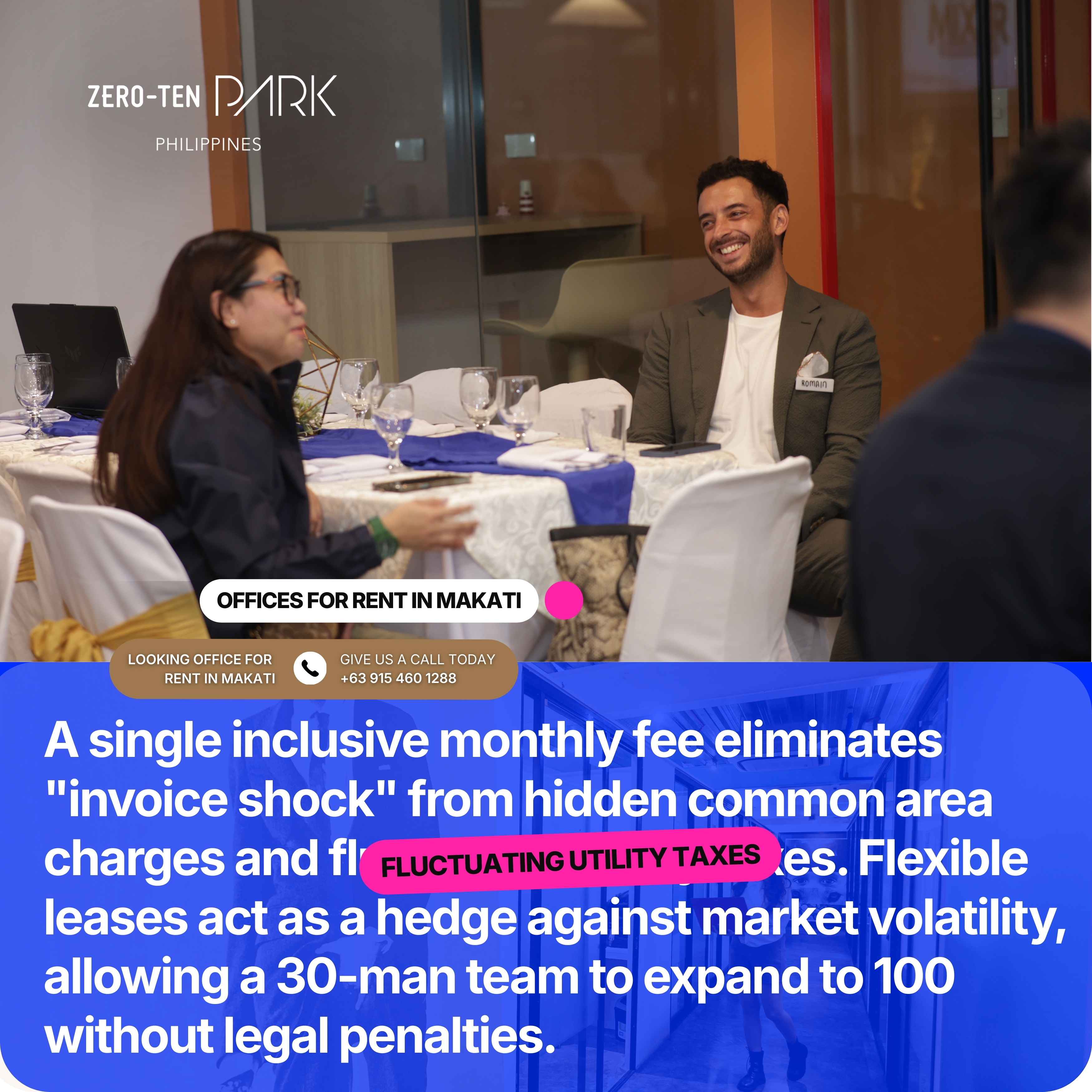
A strategic executive center simplifies this “forensic” mess by offering an all-inclusive rate. This transparency allows your finance department in Japan or Australia to forecast budgets with 100% accuracy, eliminating the “invoice shock” that comes with fluctuating utility bills and surprise maintenance assessments.
Lease Flexibility as Risk Mitigation
A traditional lease in Makati typically locks a tenant into a 3-to-7-year commitment, often backed by heavy “Restoration Clauses” that require you to demolish your improvements and return the space to its raw concrete state upon exit.
For a fast-growing company, this is a major liability. What happens if your 30-man team grows to 80 in eighteen months? Or if a global shift requires a headcount reduction? High-tier centers offer “Modular Scalability,” allowing you to expand your footprint within the same facility without the legal penalties of breaking a long-term contract. This flexibility acts as a hedge against market volatility, ensuring your real estate footprint always matches your current business reality.
NAVIGATING REGULATORY AND OPERATIONAL LANDSCAPES
Expanding a multinational footprint requires navigating a “regulatory maze” that can significantly impact your net profitability. In the Philippines, two critical concepts often decide the speed and cost of your entry: PEZA Accreditation and Employer of Record (EOR) services.
PEZA (Philippine Economic Zone Authority) is a government agency that designates specific buildings or zones as “Special Economic Zones.” Companies registered under PEZA enjoy aggressive tax incentives. An Employer of Record (EOR) is a third-party service provider that legally employs staff on your behalf. This allows you to hire a local team without having to wait months for your own local entity (subsidiary) to be formally incorporated.
Maximizing Fiscal Incentives: The PEZA Advantage
For decision-makers from high-tax jurisdictions like the UK or Japan, the fiscal incentives in the Philippines are a major draw. Choosing an Executive Center in Makati that is located within a PEZA-accredited building is a move that can save millions in annual overhead.
Under the CREATE MORE Act of 2024, qualified export-oriented enterprises (including IT and BPO firms) can enjoy a VAT zero-rating on local purchases, including office rent and utility bills. Instead of paying the standard 12% VAT and waiting for a refund, the tax is simply not applied. Furthermore, after an initial Income Tax Holiday (ITH) of 4 to 7 years, firms can transition to a Special Corporate Income Tax (SCIT) of just 5% on gross income. By selecting a center that already holds the necessary building-level accreditations, you simplify your path to these government-backed savings.

Accelerated Market Entry: The EOR Strategy
One of the biggest hurdles for multinational startups or 30-man satellite teams is the “Incorporation Gap”—the 3 to 6-month period required to register with the SEC and open local bank accounts.
Forward-thinking executive centers often provide or partner with Employer of Record (EOR) services. This allows your company to “soft land” by hiring local talent immediately under the provider’s legal infrastructure. You maintain full operational control over your staff’s daily tasks, while the EOR handles payroll, 13th-month pay, and mandatory contributions (SSS, PhilHealth, and Pag-IBIG). This strategy de-risks your entry, allowing you to test the market and scale your team while your legal department finalizes your long-term corporate structure in the background.
Multilingual and Cultural Support
Beyond the paperwork, there is the “Cultural Infrastructure.” For a company with a base in Japan or Europe, navigating local labor laws and hiring etiquette can be daunting. Premium centers act as more than just landlords; they provide a specialized concierge layer. This includes access to multilingual staff and on-site legal consultants who understand the nuances of the Philippine Labor Code. This support ensures that your executive center isn’t just a place to work, but a fully supported ecosystem that understands the high-compliance standards required by a global headquarters.
STRATEGIC LOCALIZATION: CHOOSING THE RIGHT SUB-DISTRICT
In sophisticated real estate planning, we use the term “Strategic Localization.” This is the practice of selecting a specific micro-neighborhood based on how its “vibe” and infrastructure align with your corporate identity. Within the Makati CBD, we distinguish between Planned Unit Developments (PUDs)—highly regulated, master-planned areas—and Mixed-Use Villages, which offer a blend of residential and commercial utility.
Understanding the “Floor Area Ratio” (FAR) of these zones is also helpful; it determines the density and height of buildings in a specific area. A high-FAR zone like Ayala Avenue feels like a canyon of glass and steel, whereas a lower-density village like Legazpi offers more “breathing room” and greenery.
Ayala Avenue: The Core of Institutional Prestige
For a multinational company seeking to project an image of absolute stability and power, Ayala Avenue is the non-negotiable choice. Known as the “Wall Street of the Philippines,” this strip houses the highest concentration of Prime and Grade A towers.
Establishing an Executive Center in Makati along this corridor provides immediate “institutional gravity.” It is the ideal location for a headquarters that requires frequent high-level meetings with bank CEOs and government officials. The trade-off is a faster, more formal pace of life and the highest rental benchmarks in the country. However, for Japanese firms that prioritize a prestigious business address as a mark of corporate honor, the “Ayala” name remains the ultimate benchmark.
Legazpi and Salcedo Villages: The Walkable CBD
If your team of 30 to 50 professionals consists of younger, tech-savvy talent or creative “knowledge workers,” the villages offer a different strategic value.
- Legazpi Village: Preferred for its “hip” and easy-going lifestyle. It blends high-rise offices with tree-lined streets, boutique coffee shops, and the famous Legazpi Active Park. It’s perfect for firms from Australia or Europe that value work-life balance and a “neighborhood” feel.
- Salcedo Village: Similar to Legazpi but with a slightly more “old-world” professional atmosphere. It is home to various embassies and consultancy firms, offering a quiet, community-oriented environment that still maintains high-speed enterprise infrastructure.
Rockwell Center: The Exclusive Enclave
Rockwell Center is a “city within a city” located just on the fringe of the main CBD. It is a high-security, ultra-upscale enclave that appeals to firms seeking maximum privacy and an elite ambiance. With its own luxury mall (Power Plant Mall) and high-end residential towers, Rockwell is the preferred choice for decision-makers who want their Executive Center to double as a world-class lifestyle hub for their expatriate leadership.
Choosing Your “Micro-Climate”
Localization is about matching the environment to your mission. While Ayala Avenue offers the “Power Move,” Legazpi offers “Talent Retention,” and Rockwell offers “Exclusivity.” By selecting the right sub-district, you aren’t just choosing a location; you are choosing the social and professional “micro-climate” in which your team will either merely function or truly thrive.
BUILDING A FOUNDATION FOR 2026 AND BEYOND
As we look toward the fiscal year 2026, the real estate landscape is experiencing what economists call a “Market Pivot.” This occurs when the balance of power shifts from the tenant to the landlord. A key metric to watch is the Vacancy Rate Absorption—the speed at which available office spaces are being filled. When absorption is high and the Supply Pipeline (new buildings currently under construction) is thin, prices begin to climb, and “landlord concessions” (like free rent periods or fit-out allowances) begin to disappear.
Market Forecast: The 2026 Landlord’s Market
The data for 2026 is clear: Makati is entering a period of “Selective Scarcity.” While other parts of Metro Manila still struggle with high vacancies, the Makati CBD has seen its vacancy rate plunge toward 5.5%. For a decision-maker, this indicates that the window for securing prime real estate at post-pandemic rates is rapidly closing.
Because no major new office towers are scheduled for completion in the Makati core until closer to 2029, the existing inventory of “Grade A” space is being aggressively absorbed by multinational banks and expanding IT-BPM firms. Securing an Executive Center in Makati today is therefore not just an operational move; it is a “First-Mover” financial hedge. By locking in a managed solution now, you bypass the rising costs and diminishing choices that will define the market over the next 24 months.

The Strategic Mandate: Choosing a Growth Catalyst
For companies originating in Japan, Australia, or Europe, the goal of expansion is rarely just to “have an office.” The goal is to build a high-performance engine that can drive regional growth. A traditional lease often becomes a “weight” on that engine—distracting leadership with facility maintenance and locking capital into static infrastructure.
In contrast, a premier executive center like Zero-Ten Park Philippines serves as a catalyst. It provides the elite prestige of a Makati address, the technical redundancy of a global data center, and the financial agility of a modern startup. It allows your 30-to-50-man team to operate with the sophistication of a Fortune 500 company from day one.
The Path Forward
As you deliberate with your partners and fellow decision-makers, consider the “Cost of Delay.” In a market where quality space is shrinking, the most expensive office is the one you couldn’t secure when your team was ready to scale. The foundation you build in 2026 will determine your trajectory for the next decade.
Choosing a partner that understands the intersection of Japanese precision and Filipino talent is the final piece of the puzzle. At Zero-Ten Park, we don’t just provide desks; we provide the operational runway for your global ambitions.
CONCLUSION: THE ZERO-TEN ADVANTAGE
In the final phase of site selection, we look for a “Turnkey Solution.” This is a product or service that is ready for immediate use—you simply “turn the key” and begin operations. In the workspace industry, this is often characterized by Hospitality-Grade Operations, where the management of the office follows the same high standards of service and attention to detail found in luxury hotels. At the heart of this philosophy is Omotenashi, a Japanese concept of wholehearted hospitality that anticipates a guest’s (or tenant’s) needs before they are even expressed.
ZERO-TEN PARK PHILIPPINES: WHERE STRATEGY MEETS EXECUTION
As you finalize your plans for 2026, the choice of partner becomes as critical as the choice of district. Zero-Ten Park Philippines, also known locally as The Company Makati, represents the pinnacle of this new office paradigm. Located on the 11th floor of the Frabelle Business Center in the walkable heart of Legazpi Village, this hub is designed specifically for the global decision-maker. It is not merely a collection of desks; it is a high-performance ecosystem backed by the precision of Japanese engineering and the agility of a global innovation network.
For a multinational firm or a scaling 30-to-50-man team, Zero-Ten Park offers a unique “Soft Landing” platform. By choosing an Executive Center in Makati operated by a brand with deep roots in Japan (Fukuoka), you gain access to specialized infrastructure like:
- The Japanese Desk: Bilingual support that understands the meticulous standards of Japanese corporate culture.
- Integrated EOR Services: The ability to hire local Australian, US, or European-managed teams instantly without waiting for local incorporation.
- Enterprise-Grade Resilience: 100% power redundancy and dual-failover fiber internet, ensuring your global “Always-On” mandate is never compromised.
The Strategic Conclusion
Your executive center is the physical manifestation of your brand’s ambition in Asia. In a market like Makati, where the “Flight-to-Quality” is accelerating and prime space is becoming a rare commodity, settling for a traditional, rigid lease is an unnecessary risk.
By partnering with Zero-Ten Park, you are choosing a space that moves with you—scaling from a lean pilot team to a robust regional headquarters without the CAPEX burden or the legal friction of the past. It is time to move beyond “renting space” and start “buying speed.” Makati is ready for your leadership; Zero-Ten Park is ready to provide the foundation.
Beyond the Desk: Our Strategic Support Suite
We understand that for your teams—whether a lean pilot group or a 50-man operation—the office must be a catalyst for growth, not a source of administrative burden. Here is how we assist our partners:
- The Japanese Desk: For firms with bases in Japan, our dedicated Japanese Desk provides bilingual support and a deep understanding of Omotenashi. We bridge the cultural gap, ensuring your corporate standards are maintained with meticulous precision.
- Instant Market Entry (EOR): We help you bypass the months-long incorporation process. Through our Employer of Record (EOR) and payroll services, you can legally hire and onboard local Filipino talent in a matter of days, allowing you to generate revenue while your legal entity is finalized in the background.
- Build-to-Suit Scalability: Unlike rigid traditional leases, we offer “Modular Growth.” Our Executive Center in Makati allows you to start with a private suite and scale into a fully branded, custom-designed floor as your team grows, all without the massive upfront CAPEX of a bare-shell fit-out.
- Business Matching & Incubation: Every member gains privileged access to our regional network across Singapore, Vietnam, and Japan. We proactively facilitate introductions to local regulators, vetted legal partners, and potential B2B clients, transforming your office into a proactive business-matching engine.
- Mission-Critical Infrastructure: We provide the “Always-On” reliability required by US, UK, and Australian operations. With 100% power redundancy and Tier-1 fiber connectivity (up to 800 Mbps), your connection to headquarters remains seamless, regardless of local utility fluctuations.
✨ YOUR OFFICE IN THE HEART OF LEGAZPI VILLAGE
At Zero-Ten Park Makati, we don’t just provide square footage; we provide a strategic launchpad designed to eliminate the friction of international expansion. Backed by the global network of Zero-Ten Park Japan and Fukuoka Jisho, our facility at the Frabelle Business Center in Legazpi Village is engineered to support the sophisticated needs of multinational decision-makers.
FREQUENTLY ASKED QUESTIONS
The primary advantage is the elimination of CAPEX (Capital Expenditure). In a traditional lease, you would be responsible for “fitting out” a bare shell—installing everything from flooring to fiber optics—which can cost between ₱50,000 and ₱75,000 per square meter. An Executive Center in Makati like Zero-Ten Park provides a “turnkey” solution, meaning the office is fully furnished and IT-ready. This allows you to convert a massive upfront investment into a predictable, tax-deductible OPEX (Operating Expenditure).
PEZA (Philippine Economic Zone Authority) accreditation is a game-changer for fiscal efficiency. If your company is export-oriented (serving clients outside the Philippines), operating from a PEZA-certified center like our Frabelle Business Center location allows you to enjoy VAT zero-rating on your rent and utilities. For a 50-man team, this 12% saving on monthly overhead can amount to millions of pesos in reclaimed capital annually.
Yes. One of our most valuable services at Zero-Ten Park is the Employer of Record (EOR) bridge. We understand that SEC registration and bank account openings can take months. By utilizing our EOR services, you can legally hire, pay, and manage your local team under our corporate umbrella immediately. This allows you to maintain “speed-to-market” while your legal department handles the background paperwork.
N+1 Redundancy is a technical standard ensuring that for every critical system (N), there is at least one independent backup (+1). In Makati, this is vital for power and internet. At Zero-Ten Park, if a primary generator or fiber-optic line fails, our secondary systems engage instantly. This “Always-On” infrastructure is essential for firms supporting global time zones in London, New York, or Tokyo, where even a few minutes of downtime is unacceptable.
Absolutely. While Ayala Avenue represents the “institutional” core, Legazpi Village has become the preferred choice for modern multinational satellite offices. It offers a unique balance of walkability and prestige. Being in Legazpi allows your executives to walk to 5-star hotels and the Greenbelt district while providing your employees with a safer, greener, and more “lifestyle-oriented” environment. It is the district where high-level business meets a high quality of life.
GET A QUOTE TODAY
"*" indicates required fields
Ready to level up your business presence and save more every month? Complete the form now and our team will handle the rest.