

Forget the Traditional Office Lease: Why Plug and Play Office in Makati is Your Best Financial Move (Especially in Metro Manila!)

The Myth of the "Cheap" Traditional Office in Makati
Hey, so you’re hunting for an office for rent in Makati? Great! But wait… before you sign that traditional lease for a bare space, let’s talk about the real picture. That low headline rent? It’s a total money illusion! You see that attractive price tag and think you’re saving money, but you’re actually buying into a massive, hidden liability.
Most teams completely miss the huge, immediate cash shock and all the long-term headaches that come with a standard office. We’re talking about cash that gets completely tied up, operational risks you shouldn’t have to carry, and zero room to maneuver if your business changes. What you really need to look at is the Total Cost of Occupancy (TCO), factoring in all the risk and lost opportunity. Trust me, PnP (Plug-and-Play) wins hands-down every time for modern, growing businesses. We’re talking about flexibility being less of a nice-to-have and more of a financial must-have, in the Philippines and everywhere else!
The Instant Cash Drain (A Real Shocker!)
Sign a traditional lease in a prime Makati tower, and BAM! You’re hit with two massive, cash-sucking requirements right away. This is money that should be growing your core business, hiring talent, or developing new products, not sitting idle in a landlord’s bank account.
Tons of Cash Just to Get the Keys: The Illiquidity Trap
Want an office for rent in Makati? Get ready to shell out serious cash just for deposits. It’s standard practice here in the Philippines to demand a huge sum upfront, and it makes sense—landlords want security!
- Advance Rent: Usually 3 months’ worth, right at the start. This part is okay; it covers your first few months.
- Security Deposit: This is the killer. It’s another 3 to 6 months’ worth of rent, which they hold for the entire contract (could be 3 to 7 years!). That money is now frozen, serving as collateral. And here’s the kicker: getting that deposit back when you leave often turns into a messy, months-long dispute over “damages” or minor wear and tear. You can’t rely on having that cash back quickly, if at all! This deposit is non-interest bearing; it’s literally dead capital that you can’t use for business growth.
Example: The 50-Seat Office in Makati Imagine you’re leasing a 100 square meter space for 50 BPO staff.
- Monthly Gross Rent: (Around ₱1,200/sqm, including CUSA) = ₱120,000.
- Total Initial Deposits: That’s 9 months’ worth tied up immediately, totaling a whopping ₱1,080,000! That’s over a million pesos you can’t touch, just to start.
The Dreaded Fit-Out (The CAPEX Nightmare)
That “bare shell” you rented? It’s literally just concrete, unfinished ceilings, and no wiring. Turning it into a usable Category B office demands a giant capital expenditure (CAPEX) for furniture, wiring, walls—everything! You are now becoming a project manager, a construction expert, and an interior designer all at once.
What exactly are you paying for?
- Construction: Walls, glass partitions for meeting rooms, dropped ceilings, and flooring.
- Critical Infrastructure: Modifying the building’s HVAC system to suit your layout, installing fire suppression sprinklers, and wiring up the entire office with specialized data and electrical cabling. This isn’t just plugging in a router!
- Furniture & Fixtures: Desks, ergonomic chairs (which are expensive!), lockers, kitchen appliances, and reception counter.
Fit-out costs in Manila are huge, ranging from a minimum of ₱10,000 to over ₱55,330 per square meter.
For our 100 square meter office, you’re looking at spending anywhere from ₱1 Million to over ₱5.5 Million just on construction and furniture.
The Added Burden of Asset Management and Tax: Once you buy it, you own it. This means you now have to track these assets, deal with depreciation schedules, and worry about selling or disposing of the furniture when you move out years later. It’s an entire extra layer of accounting complexity. Plug and play offices in Makati, by contrast, are a service—a simple expense, immediately tax-deductible as OPEX, simplifying your accounting massively.
Total Cash Out: When you add the deposits and the construction bill, your total initial cash requirement for that 50-seat office in Makati easily ranges from ₱2 Million to over ₱6.6 Million before anyone even plugs in a laptop!
Wasting Time and Losing Money (Opportunity Cost)
Seriously, time is money! Traditional leases force you into this long, non-revenue-generating waiting game that can totally derail growing companies. Every week spent waiting is a week lost on servicing a client or generating revenue.
After signing, you’re waiting three to six months (or sometimes even longer!) for:
- Designs and Plans: Finalizing the layout and getting approval from the building administration.
- Permits: Navigating the complex local government unit (LGU) and city hall permitting process for electrical, mechanical, and building works in Metro Manila. This is often where things get stuck! Project delays are incredibly common in the Philippines, and the landlord doesn’t care—you still pay rent on the empty, unfinished space.
- Contractor Management: Bidding, hiring, supervising, and managing a construction project.
The Loss of High-Value Employee Time: During that entire mobilization phase, you’re already obligated to pay rent and fees on an empty, noisy construction zone. That’s not all. You also have to dedicate high-value employees—a facilities manager, an IT lead, maybe even a lawyer—to manage the project. Their salaries for that six months, plus the rent on the unused space, means that ₱720,000 in rent is gone, plus potentially hundreds of thousands more in internal project management salaries, just for waiting!
The HR Nightmare of Delays
This waiting game has a huge impact on your Human Resources strategy. If your business depends on a large hiring push, a delay in opening the office means:
- Delayed Onboarding: New hires sit idle or work remotely longer than planned, delaying productivity.
- Talent Loss: High-demand employees might take offers elsewhere if they feel the company isn’t stable or ready to receive them.
- Recruitment Freeze: You can’t start hiring until the office completion date is firm, stalling your growth plans.
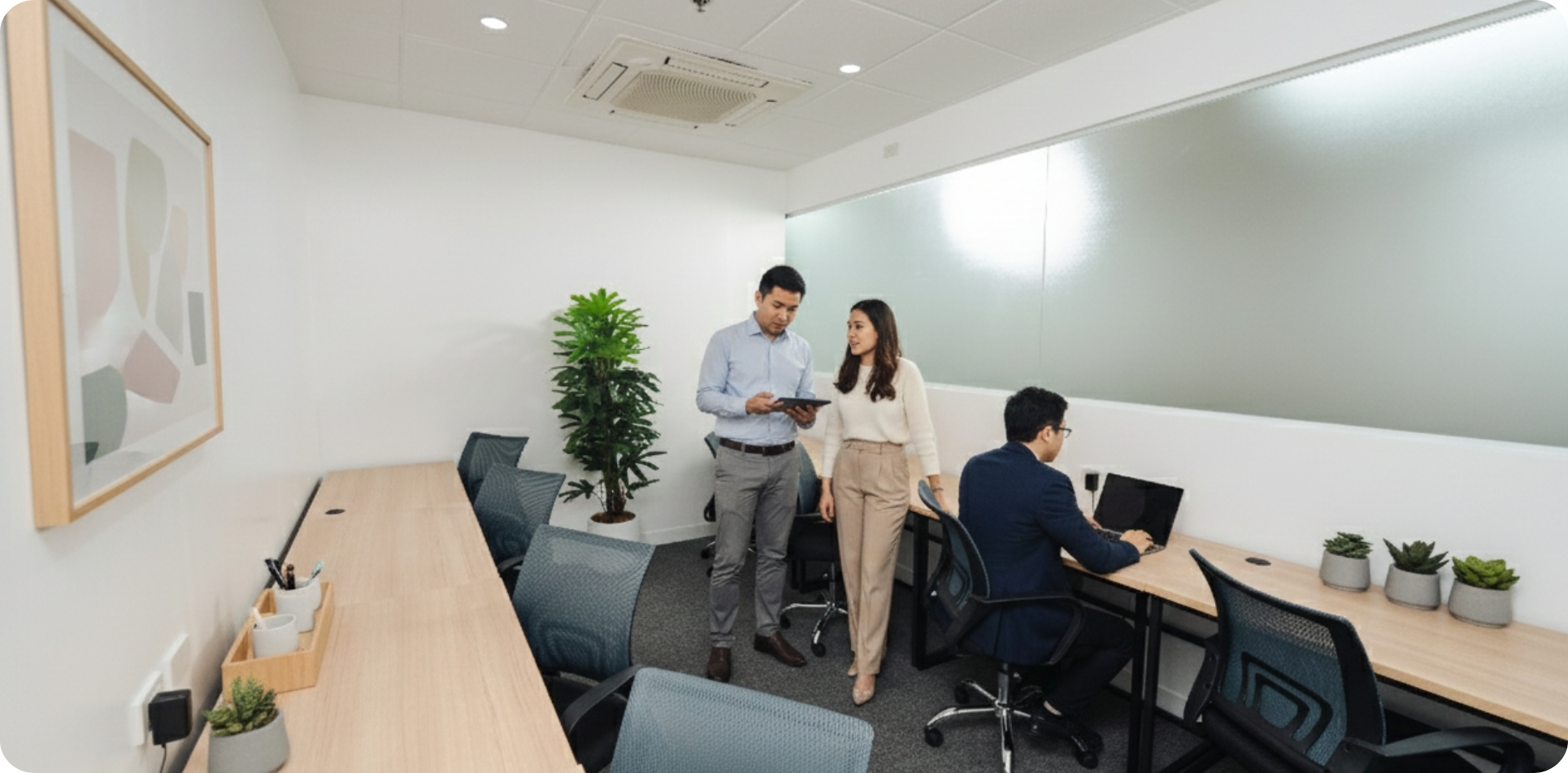
The PnP Advantage: Plug and play offices in Makati are instant! Your team can move in and start making money in literally 48 hours after signing. Talk about speed-to-market—it’s the ultimate business advantage. You bypass all the construction delays, permitting hell, and project management costs completely, allowing your HR team to execute hiring campaigns with confidence.
All the Little Bills Add Up (The Commitment Multiplier)
Don’t just look at the base rent (that “office for rent in Makati” number). You need to think about everything else that gets bundled up in PnP but you have to manage yourself in a traditional space.
Those Shifty CUSA Fees and Power Issues
With a traditional lease, you pay base rent plus mandatory CUSA (Common Use Service Area). The problem? These charges are wild! They jump up unpredictably, exposing your company to utility spikes and inefficiencies. Plus, traditional leases almost always include an annual rent escalation clause, typically 3% to 5% every year. That low headline rate you loved? It’s not staying low!
And let’s be real: given Metro Manila’s infrastructure, any globally connected operation has to spend serious money on backup power (gensets, UPS) and contracts with multiple expensive internet lines. If the power goes out, the entire cost and burden of getting the system back online is yours, along with the productivity loss from downtime.
The PnP Advantage: The fixed, all-inclusive monthly PnP fee bundles all utilities, backup power, high-speed fiber internet, and maintenance. The PnP provider takes the risk of utility failure and the complex administrative burden, guaranteeing you a highly predictable monthly bill that typically doesn’t jump drastically year-over-year.
The High Cost of IT and Network Ownership
In a traditional office, you own the network infrastructure. This means you must purchase, install, and constantly upgrade expensive networking equipment (servers, firewalls, switches). Every time you scale or technology changes, you face another unplanned CAPEX cycle.
- Security Liability: Maintaining security patches and compliance (e.g., ISO certifications) for your own network is a full-time job.
- Scaling Complexity: Adding 20 seats means buying new switches, pulling new wires, and configuring ports.
The PnP Advantage: When using plug and play offices in Makati, you simply connect to the provider’s robust, secure, and fully managed network. They handle the upgrades, security, maintenance, and compliance, offering guaranteed SLAs for uptime. It’s an instant, scalable IT backbone without the CAPEX or the headache.
The Invisible Staff Costs (Management Drag and Employee Experience)
A traditional office is a massive time sink for your leadership. We call it management drag. You have to use your HR, IT, and facilities managers to deal with non-core, non-revenue-generating tasks like:
- Hiring and managing cleaners and security staff.
- Maintenance Nightmares: When the air conditioning breaks down (a common Manila issue!), the leaky pipe floods the server room, or the elevator gets stuck, the financial liability and the urgent management headache is 100% yours. You pay for the repair and the time your employees spend complaining.
- Managing vendor contracts for everything from pest control to specialized server maintenance.
- Disposing of outdated furniture.
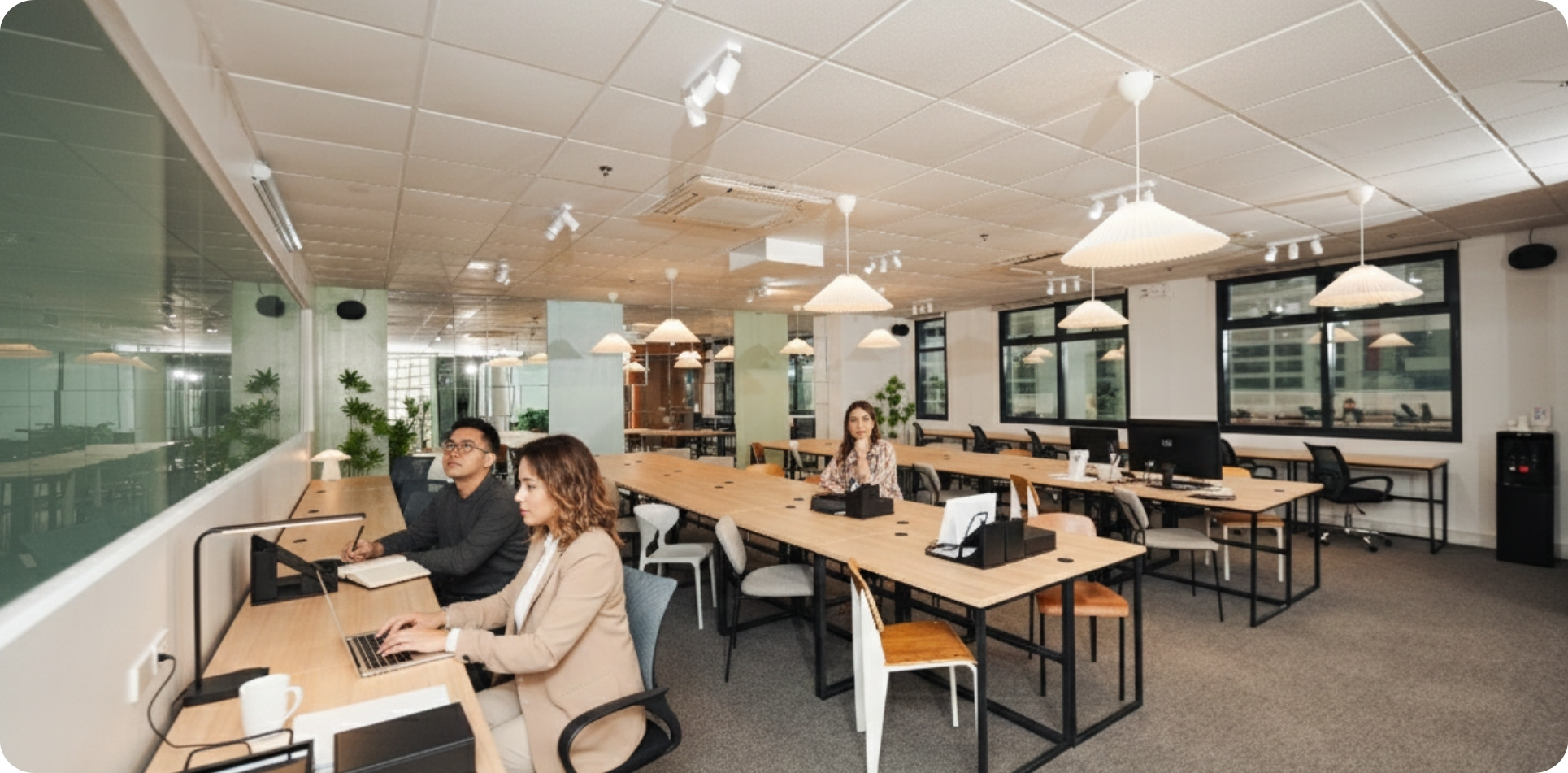
- The Employee Experience (EX) Gap: Reputable plug and play offices in Makati provide premium amenities—barista coffee, modern lounges, community events—included in the price. To replicate this level of EX in a traditional office, you’d have to purchase, stock, and manage all those services yourself, driving up your operating costs further.
The PnP Advantage: You outsource this entire headache! The PnP fee includes the support staff (reception, IT support, facilities crew) and the premium amenities. It changes a complex, stressful, variable internal cost into a nice, simple, fixed part of your bill. Freedom! The PnP provider handles the leaky pipes and broken HVAC units so your team can focus on the business.
Flexibility is King (Scalability and Global Trends)
In today’s crazy economy, flexibility isn’t just nice—it’s the most valuable thing you can have in corporate real estate, both here in Asia and globally.
Grow or Shrink? PnP Doesn't Care!
Traditional leases lock you into a fixed size for 3–7 years. If your headcount contracts (attrition or downsizing), guess what? You’re stuck paying for empty seats! You are literally paying rent on an asset you aren’t using. Breaking the lease is usually financially prohibitive, demanding payment of all remaining rent.
PnP works on per-seat economics.
- If your team of 50 shrinks to 40, your real estate cost instantly contracts by 20%!
- If you need 10 more, you just add them—no construction, no new furniture, no complex lease renegotiations. It scales perfectly with your team.
Geographical Agility: What if you want to test a satellite office in BGC or Alabang? A PnP agreement often allows you to quickly shift teams or open a smaller secondary site without being shackled to a massive 5-year lease in Makati. That kind of freedom is priceless for strategic planning. This agility is a key defense against economic volatility and unexpected market shifts.
The Massive Cost of Exit (The "Make Good" Clause)
Here’s another massive hidden trap in traditional leases: the “Make Good” or “Reinstatement” clause. When your lease finally expires in 5 or 7 years, the landlord often requires you to strip the office back to its original bare-shell state!
- This means paying for a second construction project—demolition.
- You pay contractors to tear down the walls you built, rip out the flooring, remove the expensive wiring, and dismantle the AC modifications.
- The cost of demolition and disposal can easily run into hundreds of thousands of pesos, adding an enormous final cost to your TCO.
The PnP Advantage: Your exit strategy from plug and play offices in Makati is simple: you pack your computers and go. There are zero reinstatement costs, zero demolition fees, and zero disputes over the physical structure. It’s a clean, financially predictable break.
Seriously, Use the Right Metric (Risk-Adjusted TCO)
When you’re comparing an office for rent in Makati, stop using that simple “Cost per Square Meter” metric. It’s meaningless and misleading!
Smart leaders, from Silicon Valley to Singapore, use the Risk-Adjusted Total Cost of Occupancy per FTE (Full-Time Employee). This is the only way to really measure the true value of avoiding operational risk, CAPEX, and gaining instant agility.
| Comparative Cost Element | Traditional Lease (3-Year Risk Profile) | Plug-and-Play (3-Year Risk Profile) |
|---|---|---|
| Upfront Capital Commitment (CAPEX) | Extreme (₱2.35M – ₱8.85M). Required asset management and depreciation tracking. | Zero. Simple OPEX model; no asset tracking needed. |
| Operational Costs | Variable, exposed to utility spikes, CUSA, and repair costs. Plus annual escalation risk. | Fixed, all-inclusive, predictable monthly OPEX. Stable cost base. |
| Infrastructure Risk (Downtime) | Tenant bears all cost and risk of power/IT failure, maintenance, and repair bills. Exposed to “Make Good” demolition costs upon exit. | Risk transferred to provider (managed via SLA). Zero repair or reinstatement liability for the tenant. |
| Scalability Efficiency | Extremely Low (Fixed rent on unused space). Penalties for downsizing. HR/Hiring stalled by delays. | High (Cost scales linearly with headcount). Easy, instantaneous expansion/contraction. HR team can execute hiring immediately. |
| Speed-to-Market | 3-6 month mobilization delay (plus internal project management cost). Lost revenue opportunity. | Immediate occupancy (48 hours). Zero management time required. Revenue generation starts immediately. |
Conclusion: It's Simple—Choose Agility
Look, for the vast majority of BPO, tech, and back-office teams in Makati, the strategic cost of a traditional lease far exceeds the marginal benefit of full customization. That bare-shell space is a beautiful financial trap, designed to lock in your capital and transfer all operational risk directly onto your balance sheet.
The Plug-and-Play solution changes your real estate from a huge, stressful capital liability into a flexible, predictable monthly expense. It shields you from market chaos, operational meltdowns, and all that crazy legal jargon that locks you in for half a decade. By moving to OPEX, you free up millions of pesos that can be reinvested into what really matters: your people and your core product. Ultimately, choosing plug and play offices in Makati is choosing speed and financial security over rigidity and risk.
Our Final Tip: When hunting for an office for rent in Makati, always go PnP for growth, expansion, and new market entries. Save the traditional lease only for those rare, specialized functions that you know will be there for five years or more and require deep, permanent customization. For everyone else? Agility rules!
✨ READY TO EXPAND YOUR BUSINESS IN MAKATI?
Elevate your local business in Makati City with a secure legal foundation. Our all-in-one Foundation Package simplifies the compliance process so you can focus on growth. Our business registration package starts at just ₱30,000.
You can also get a Virtual Office starting at ₱3,500.00 per month or an office at ₱15,000.00 per month. Complete the form below for more details.
FREQUENTLY ASKED QUESTIONS
Legazpi Village offers the perfect balance: a prestigious address near Makati’s financial core but in a quieter, tree-lined setting. It provides excellent amenities (cafes, parks) and a great quality of life, which helps attract and retain top talent. It’s the sophisticated choice for an office for rent in Makati.
Read more about it here.
A Makati location is crucial. As the undisputed financial hub of the Philippines, it gives your business immediate credibility and a professional image, which is vital when dealing with corporate clients, banks, or international partners. It positions you right at the heart of the country’s economic activity.
Yes, most PnP providers are flexible. While the space is ready-to-use, they can usually integrate dedicated fiber lines, private VLANs, and enhanced physical security measures (like specific door biometrics or customizable server racks) to meet specialized requirements. Always discuss these specific needs upfront.
The process involves four main steps: registration with the SEC (or DTI for sole proprietors), securing a Barangay Clearance, obtaining the Business Permit (Mayor’s Permit) from Makati City Hall, and finally, registering with the Bureau of Internal Revenue (BIR). PnP providers often help streamline this process by providing the necessary address documentation instantly.
Read more about it here.
Traditional offices demand long, rigid terms (3 to 7 years). PnP offers far greater flexibility, with license agreements often available monthly, 6-monthly, or annually. This short-term option is key for growth and contraction, allowing your costs to scale precisely with your headcount without being penalized for downsizing.

GET A QUOTE TODAY
"*" indicates required fields
Ready to level up your business presence and save more every month? Complete the form now and our team will handle the rest.