

A Startup Founders’ Guide to Employee Retention and Growth in the Philippines

Building a remote team in the Philippines is often framed as a “cost-saving play,” but in today’s hyper-competitive global talent market, that mindset is a fast track to high turnover and operational friction. To succeed, you must move beyond the “back-office” mental model and view the Philippines as a strategic hub of high-intellect, high-loyalty talent.
We have integrated the core pillars of retention with real-world events that have shaped the Filipino labor landscape in 2024 and 2025:
PILLAR 1: COMPETITIVE COMPENSATION AND ESSENTIAL BENEFITS
Building a remote team requires understanding that while your costs are lower than in the West, your employees are facing a unique set of local economic pressures. To maintain a stable workforce, you must master three core areas: market-aligned wages, statutory requirements, and specialized healthcare.
1. Fair Market Wages: Beating the "Inflation Trap"
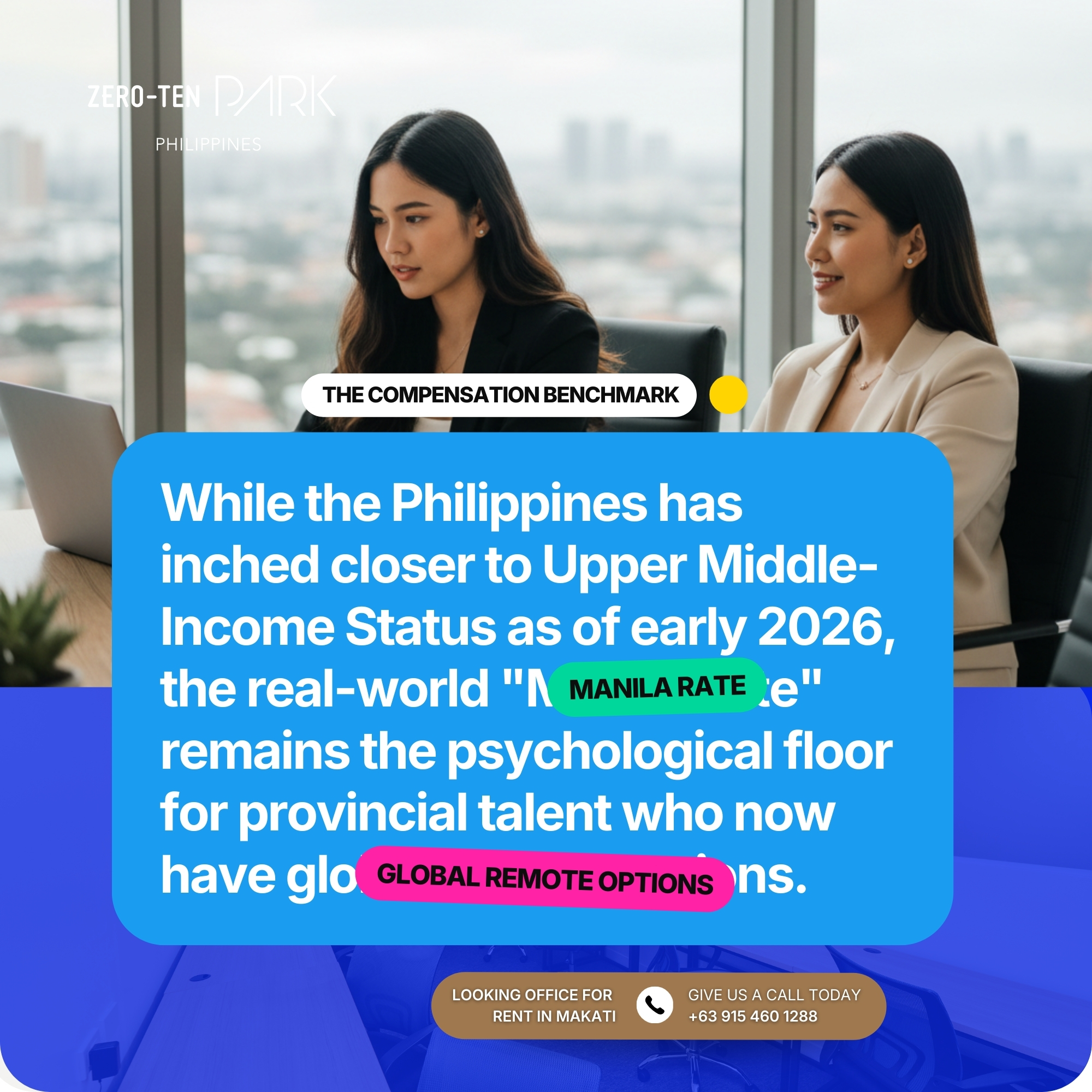
In the Philippines, the National Capital Region (NCR)—which includes Manila—serves as the economic benchmark. However, even for fully remote workers living in provinces, the “Manila Rate” is often the expectation for high-skilled talent.
In early 2025, the Philippines reached “Upper Middle-Income Status,” driven by a 6.1% GDP growth. While this is a sign of a thriving economy, it has come with a surge in the cost of core services like housing and private education.
Do not peg your salaries to the Philippine minimum wage (which is roughly PHP 645/day). Instead, look at the Skilled Professional Benchmark. For 2025, skilled remote roles (like VAs or Graphic Designers) typically range from PHP 45,000 to PHP 60,000 per month, while tech roles often exceed PHP 90,000. Failing to adjust for the annual 5.5% average salary increase in the tech sector will lead to high attrition.
2. The 13th-Month Pay: A Non-Negotiable Cultural Pillar
One of the most common points of confusion for foreign employers is 13th-Month Pay.
13th-Month Pay is a legally mandated form of monetary benefit equivalent to one-twelfth (1/12) of the basic salary of an employee within a calendar year. It is not a discretionary Christmas bonus; it is a statutory requirement.
As of December 2024 and throughout 2025, the Department of Labor and Employment (DOLE) has increased its monitoring of 13th-month compliance. For a remote team, paying this by the December 24 deadline is the single greatest factor in building “Malasakit” (loyalty). It is the money families use for Noche Buena (the traditional Christmas Eve feast) and year-end debt clearing.
3. The HMO: The "Gold Standard" of Benefits
In a country where public healthcare can be overburdened, an HMO is often more valuable than the cash equivalent in salary.
An HMO (Health Maintenance Organization) is a private healthcare provider that gives employees access to a network of hospitals and doctors for a fixed annual fee, usually covering everything from check-ups to emergency surgeries.
In the first half of 2025, healthcare benefits paid out by Filipino HMOs rose by nearly 20%, reflecting a massive surge in medical costs.
While the government-mandated PhilHealth (public health insurance) is required, it rarely covers the full cost of private hospitalization. Offering a private HMO (like Etiqa or Intellicare) that includes dependents (family members) is the #1 reason Filipino talent chooses one remote startup over another.
Summary Table: Compensation Benchmarks
| Benefit Type | Status | 2025 Context |
| Basic Salary | Competitive | Target PHP 45k–60k for mid-level remote pros to outpace inflation. |
| 13th-Month Pay | Mandatory | Must be paid by Dec 24; calculated as (Total Basic Salary / 12). |
| HMO (Private) | Highly Expected | Essential for retention as private medical costs rose 20% this year. |
| Statutory (SSS/Pag-IBIG) | Mandatory | Social security and housing funds; ensures long-term stability for the worker. |
By mastering these financial fundamentals, you create a “gravity” that keeps your best people from drifting toward competitors. Successful Employee Retention and Growth in the Philippines starts with the peace of mind that comes from a fair, well-managed paycheck.
To build a secure foundation for Employee Retention and Growth in the Philippines, you must ensure your administrative “house” is in order. Collecting these documents early prevents payroll delays and demonstrates that you are a serious, legitimate employer.
The following table categorizes the specific documents you need to collect from a Filipino remote hire in 2025, whether you are hiring them as a direct employee (via an EOR) or as a registered independent contractor.
Pre-Onboarding Documentation Matrix
| Category | Document / Requirement | Purpose & Importance |
| Identity Verification | Two (2) Valid Government IDs | Essential for identity verification and bank account opening. Preferred: PhilID (National ID), Passport, or Driver’s License. |
| Tax Compliance | TIN (Tax Identification Number) | Required for Bureau of Internal Revenue (BIR) filings. If they don’t have one, they must register via BIR Form 1901 (Contractors) or 1902 (Employees). |
| Health & Safety | PhilHealth Number / MDR | The Member Data Record (MDR) proves they are active in the national health system. Critical for processing local health benefits. |
| Social Security | SSS Number (Personal Record) | The Social Security System (SSS) number is mandatory for all private-sector workers. It provides for their retirement and maternity/sickness leaves. |
| Housing Fund | Pag-IBIG (HDMF) Number | The Home Development Mutual Fund is a mandatory savings and housing loan program. Employees see this as a key long-term stability benefit. |
| Security Clearing | NBI Clearance | The “Gold Standard” for background checks in the PH. It proves the individual has no criminal record and is updated annually. |
| Proof of Origin | PSA Birth Certificate | A copy of the birth certificate issued by the Philippine Statistics Authority (PSA) is required for verifying age and dependent status for tax/benefits. |
| Professionalism | Signed NDA & Contract | A local-compliant contract (Telecommuting Act compliant) that defines IP ownership and the “Right to Disconnect.” |
| Academic Proof | Diploma or TOR | The Transcript of Records (TOR) verifies their educational background and specialized skills, ensuring they are a “High-Skilled” match. |
Key Jargon Defined
- PSA (Philippine Statistics Authority): The central government agency responsible for all national census and civil registration (births, marriages, etc.).
- NBI Clearance: A certificate issued by the National Bureau of Investigation confirming that the person is not a party to any criminal case in the Philippines.
- MDR (Member Data Record): A document from PhilHealth that lists the member’s information and their registered dependents.
- Telecommuting Act (RA 11165): The Philippine law that specifically governs remote work, ensuring remote workers have the same rights as office-based staff.
Pro-Tip for 2026
With the 2024–2025 push for digital transformation in the Philippines, most of these can now be verified via the eGov PH app. Asking your hire if they have their Digital PhilID ready can significantly speed up your onboarding timeline from weeks to days.
PILLAR 2: CULTURAL VALUES AND LEADERSHIP STYLE
Leadership in the Philippines is less about hierarchy and more about community. If your management style is purely transactional—focused only on tickets closed or hours logged—you will likely struggle with high turnover. Success requires a blend of empathy, trust, and frequent connection.
1. The Power of Malasakit: Leading with Genuine Concern
The most critical term for any foreign leader to learn is Malasakit.
Malasakit (mah-lah-sah-kit) is a Filipino value that roughly translates to “genuine care” or “stewardship.” In a professional sense, it means treating the company’s goals as your own, and conversely, the employer treating the employee’s well-being as their own responsibility.
Following the “Retention Crisis” projected for 2025/2026—where attrition rates in the PH are expected to hit 20%—companies that demonstrate Malasakit are the ones surviving.
Malasakit is shown during “life events.” If an employee’s area is hit by a typhoon (a frequent reality in the Philippines) or they have a family emergency, a leader who prioritizes their safety over a deadline earns a level of loyalty that money cannot buy.
2. High-Touch Communication: Bridging the Distance
In a remote setting, “High-Touch” is the antidote to the “Virtual Assistant” identity crisis.
High-Touch Communication refers to a relationship-driven model of frequent, personalized, and human-centric interaction. It prioritizes video calls, voice notes, and “non-work” check-ins over automated emails or dry Slack messages.
Recent 2025 workplace studies show that while 90% of Filipinos prefer remote work, nearly half feel a “disconnect” from their global headquarters.
Implement a “Human-First” meeting pulse. Start every 1:1 with a Kamustahan (a casual “how are you” session). Filipino culture is high-context, meaning people often communicate through tone and rapport. Without these high-touch moments, remote workers can feel like “cogs in a machine,” making them more likely to leave for a 10% pay raise elsewhere.
3. Killing Micromanagement with Trust
While Filipino culture respects authority, it thrives on autonomy.
Micromanagement is the excessive supervision of minor details. In the Philippines, this is often interpreted as a lack of trust (walang tiwala), which is culturally insulting and a top driver of “quiet quitting.”
With the 2024 passage of various digital labor protections, there is a national movement toward “output-based” performance.
Shift from “time-tracking” to “results-tracking.” Use a Coaching Model where you set the “What” (the goal) but let the employee determine the “How.” This empowers your team and fosters the professional maturity required for long-term growth.
The Cultural Leadership Checklist
| Leadership Action | Cultural Impact | Expected Outcome |
| Practice Kamustahan | Builds Relasyon (Relationship) | Higher engagement and lower feelings of isolation. |
| Show Malasakit | Builds Utang na Loob (Gratitude/Loyalty) | Extreme loyalty during high-pressure business cycles. |
| Avoid Micromanagement | Builds Tiwala (Trust) | Development of independent, proactive local leaders. |
By mastering these cultural nuances, you don’t just hire a worker; you integrate a loyal advocate into your mission. Leadership that respects the Filipino soul is the most effective tool for ensuring Employee Retention and Growth in the Philippines.
In the Philippines, holidays are not just days off; they are the anchors of family life and social cohesion.
Planning your business operations around these dates—and acknowledging them with your team—is a powerful way to demonstrate Malasakit.
2026 Philippine Cultural & Holiday Calendar
| Month | Date | Event / Holiday | Type | Cultural Significance & Leadership Tip |
| January | Jan 1 (Thu) | New Year’s Day | Regular | Media Noche: Most families stay up all night. Expect a slow start on Jan 2. |
| February | Feb 17 (Tue) | Chinese New Year | Special | A major cultural event in the PH. A great time for a “Prosperity” team shout-out. |
| Feb 25 (Wed) | EDSA Revolution | Working | A day of national reflection. Acknowledge it as a “Special Working Day.” | |
| March | Mar 20 (Fri) | Eid’l Fitr | Regular | Marks the end of Ramadan. Vital for Muslim team members. |
| April | Apr 2-5 | Holy Week | Regular/Spec | Critical: The country effectively “shuts down” from Thu–Sun. Plan no deadlines. |
| Apr 9 (Thu) | Day of Valor | Regular | (Araw ng Kagitingan) Honors WWII veterans. | |
| May | May 1 (Fri) | Labor Day | Regular | A Friday holiday. Perfect for a 3-day “Rest and Recharge” weekend. |
| June | Jun 12 (Fri) | Independence Day | Regular | The peak of national pride. Great for a cultural trivia session. |
| August | Aug 21 (Fri) | Ninoy Aquino Day | Special | Another long weekend opportunity. |
| Aug 31 (Mon) | National Heroes Day | Regular | Honors both known and unsung heroes. | |
| November | Nov 1 (Sun) | All Saints’ Day | Special | Undas: Deeply personal. Filipinos travel to hometowns to honor the deceased. |
| Nov 2 (Mon) | All Souls’ Day | Special | Often treated as a recovery day from travel. | |
| Nov 30 (Mon) | Bonifacio Day | Regular | Honors the father of the Philippine Revolution. | |
| December | Dec 8 (Tue) | Immaculate Conception | Special | A significant religious feast day. |
| Dec 24-25 | Christmas Break | Spec/Reg | Noche Buena: Christmas Eve is more important than the day itself. | |
| Dec 30-31 | Rizal & NYE | Regular/Spec | The final “Mega-Break” of the year. |
Definitions for Your Planning
- Regular Holiday: These are fixed dates. If an employee does not work, they still get 100% of their daily pay. If they work, they get 200% (Double Pay).
- Special Non-Working Day: Usually “No Work, No Pay” unless your contract says otherwise. However, if they do work, they are entitled to an additional 30% of their daily rate.
- The “Ber” Months: Starting September 1st, the Christmas season begins in the Philippines. You will notice a lift in morale. Use this “energy surge” to plan your Q4 sprints early.
Why This Matters for Retention
A foreign leader who says, “I know Holy Week is coming up, let’s clear our queue by Wednesday so you can be with your family,” is a leader who understands the heart of Employee Retention and Growth in the Philippines. You aren’t just giving them time off; you are respecting their values.
PILLAR 3: PROFESSIONAL GROWTH AND CAREER PATHWAYS
Filipino talent is among the most ambitious in Asia, but this ambition is often met with the “dead-end” reality of stagnant remote roles. To keep your best people, you must move beyond task delegation and start investing in skill transformation.
1. The Era of Reskilling and Upskilling
As we move further into 2025, the gap between current skills and market demands is widening due to technology.
Upskilling is the process of learning new skills to improve performance in a current role (e.g., a writer learning SEO). Reskilling is learning entirely new skills to transition into a different role (e.g., a customer support agent learning data analytics).
In mid-2025, the Philippine government launched a PHP 740 million upskilling initiative aimed at future-proofing 340,000 workers against AI disruption.
If your startup doesn’t offer a learning budget or internal training, your team will look to the companies that do. Use the 70-20-10 Model: 70% of learning through on-the-job challenges, 20% through mentoring, and 10% through formal courses or certifications (like Coursera or local AI boot camps).
2. Establishing Transparent Progression Pathways
A primary driver of turnover in the Philippines is the “Glass Ceiling” of remote work, where employees feel they can never rise above their initial title.
Progression Pathways are clearly defined internal roadmaps that show the specific requirements (skills, time, and performance) needed for an employee to move from one level to the next.
A 2025 Talent Trends Report revealed that nearly 64% of Filipino workers are considering a job switch this year, with “lack of career development” cited as a top three reason.
Don’t wait for an annual review. Create a “Career Matrix” that shows how a Junior Developer becomes a Lead Architect, or how a General Assistant becomes an Operations Manager. When an employee can see their 2027 self in your company, they are 2x more likely to stay.
3. Mentorship: Passing the Torch
and powerful retention tool.
Pair your emerging Filipino leaders with seasoned members of your global headquarters. This isn’t just about technical knowledge; it’s about Institutional Knowledge—the “unwritten rules” and mission-critical context that makes an employee feel like an insider rather than an outsourced helper.
The Growth Impact Table
| Initiative | Why It Works in the PH | 2025 Priority |
| AI Reskilling | Counters fear of automation. | High — Government is currently subsidizing this nationwide. |
| Dual-Track Paths | Rewards both specialists and leaders. | Medium — Essential for keeping top technical talent. |
| Certification Reimbursement | Increases the worker’s market value. | High — Shows the company is invested in their “Life Value.” |
Investing in these pathways is the most cost-effective way to secure Employee Retention and Growth in the Philippines. When you grow the person, you grow the business.
A Career Path Template provides a visual and psychological “ladder” that converts a job into a career.
Below is a structure for a Customer Success (CS) Track, which is one of the most common and vital remote roles for startups.
Remote Career Progression Template: Customer Success Track
This template uses a “Dual-Track” approach, allowing employees to choose between becoming people managers or high-level individual contributors (subject matter experts).
Level 1: Customer Success Associate (The Builder)
- Focus: Execution and Learning.
- Core Responsibilities: Responding to tickets, basic onboarding, and learning the product inside-out.
- Growth Requirement: Mastery of the internal CRM and maintaining a Customer Satisfaction (CSAT) score of 90%+.
- Jargon Definition: CSAT (Customer Satisfaction Score) is a metric used to measure a customer’s satisfaction with a specific interaction or overall experience.
Level 2: Customer Success Manager / CSM (The Advisor)
- Focus: Relationship Management and Retention.
- Core Responsibilities: Managing a specific portfolio of clients, conducting “Health Checks,” and identifying upsell opportunities.
- Growth Requirement: Demonstrated ability to reduce “Churn” within their assigned accounts.
- Jargon Definition: Churn refers to the rate at which customers stop doing business with an entity. Reducing churn is a critical KPI for growth.
Level 3: Strategic CSM or Team Lead (The Specialist or Leader)
At this stage, the path splits based on the employee’s strengths:
- Path A (Management): Focuses on “Malasakit” for the team—hiring, training, and hitting group KPIs.
- Path B (Strategic Specialist): Focuses on high-value “Enterprise” accounts or technical integration strategy.
- Growth Requirement: Successful completion of a Leadership Development Program or a specialized Technical Certification.
The Progression Matrix Table
Use this table to define exactly what is needed to “Level Up” in your organization.
| Category | Level 1: Associate | Level 2: Manager | Level 3: Senior/Lead |
| Technical Skill | Product basics & Zendesk/Intercom. | Data analysis & basic API knowledge. | Advanced workflow automation & Strategy. |
| Soft Skill | Empathy & Active Listening. | Conflict Resolution & Negotiation. | Mentorship & Stakeholder Management. |
| KPI Ownership | Response Time & Resolution Rate. | Net Retention Rate (NRR). | Lifetime Value (LTV) Optimization. |
| Growth Step | 6-12 Months | 12-24 Months | 2+ Years |
This Works for Filipino Teams
In the Philippines, professional identity is tied closely to Title Progression. Providing a path from “Associate” to “Strategic Lead” creates a sense of “Forward Motion.”
In late 2025, many “Global Capability Centers” in Manila are reporting that employees prioritize “Path Clarity” over a 15% salary increase. If they know exactly how to reach Level 3, they are less likely to be “headhunted” by competitors offering a slightly higher starting pay but no clear future.
PILLAR 4: WORK-LIFE BALANCE AND FLEXIBILITY
The Philippine work culture is historically industrious, but the “hustle culture” of the past decade is being replaced by a demand for sustainable productivity. Success in 2025 depends on respecting the boundaries between a worker’s professional output and their personal peace.
1. The "Carmageddon" Catalyst: Why Remote is Non-Negotiable
The primary driver for remote work in the Philippines isn’t just convenience; it’s the avoidance of “Carmageddon.”
Carmageddon is a local colloquialism used to describe extreme, gridlocked traffic congestion—often caused by rain, roadworks, or holiday rushes—that can turn a 10-kilometer commute into a three-hour ordeal.
In late 2025, the massive “EDSA Rebuild” project (the multi-year rehabilitation of Manila’s main artery) has triggered a renewed national clamor for mandatory work-from-home schemes. Commuters are losing an average of 117 hours per year to traffic.
By providing a fully remote or highly flexible setup, you are effectively giving your employees two to four hours of their life back every day. This “time gift” is the single most powerful retention tool available in the Philippine market today.
2. Standardizing the "Right to Disconnect"
As the home and office merge, “burnout” has become the silent enemy of Employee Retention and Growth in the Philippines.
The Right to Disconnect refers to an employee’s right to not engage in work-related electronic communications (emails, Slack, WhatsApp) during non-work hours, ensuring they can rest without fear of reprimand.
As of December 2025, the “Workers’ Rest” Bill (House Bill 10717) has gained significant momentum in the Philippine Congress. It seeks to penalize employers who coerce employees into working during their rest hours.
Don’t wait for the law to pass. Establish a clear “Dark Hours” policy for your remote team. If you are in a different time zone (e.g., New York or London), use “Schedule Send” for emails so your Filipino team doesn’t feel pressured to respond at 3:00 AM local time.
3. Asynchronous Work: Trust over Presence
The most successful remote teams are moving toward “Asynchronous” operations to accommodate the unique challenges of Philippine infrastructure.
Asynchronous Work (or “Async”) is a way of working where team members do not need to be online at the same time to move projects forward. It relies on thorough documentation rather than real-time meetings.The Philippines still faces occasional localized internet outages or “rotational brownouts” (power interruptions). An async-first culture allows an employee to work when their connection is strongest or their environment is quietest, leading to higher quality output and lower stress.
Flexibility & Balance Matrix
| Strategy | Local Impact | Retention Result |
| Location Independence | Avoids the “EDSA Rebuild” traffic. | Saves ~20 hours of commute time weekly. |
| No-Meeting Fridays | Allows for deep, focused work. | Reduces “Zoom Fatigue” and increases throughput. |
| Core Hours (4-hour overlap) | Balances global collaboration with local rest. | Prevents midnight burnout for the local team. |
| Internet/Power Stipend | Offsets costs of “working from home.” | Ensures consistent uptime and shows Malasakit. |
By prioritizing these boundaries, you build a culture where employees feel respected as humans, not just resources. A balanced employee is a loyal employee.
In the context of the Philippines’ “always-on” digital culture and the legislative momentum of late 2025, a formal Right to Disconnect clause is one of the most effective ways to signal that you value your team’s mental health.
By including this in your contracts, you proactively address the concerns raised by House Bill 10717 (Workers’ Rest Law) and the Telecommuting Act, positioning your startup as a top-tier choice for Employee Retention and Growth in the Philippines.
Sample Clause: The Right to Disconnect
Section [X]. Right to Disconnect & Digital Well-being
[X.1] Definition of Rest Hours: The Company recognizes “Rest Hours” as any period outside of the Employee’s agreed-upon working schedule (e.g., 9:00 AM to 6:00 PM PHT). This includes weekends, public holidays, and approved leave.
[X.2] Right to Disengage: The Employee has the right to disengage from all work-related electronic communications (including but not limited to email, Slack, and WhatsApp) during Rest Hours. The Employee shall not be penalized, reprimanded, or subjected to any disciplinary action for failing to acknowledge or respond to communications during these times.
[X.3] Exception for Emergencies: Contact during Rest Hours is strictly limited to “Critical Emergencies”—defined as events that threaten the immediate security of the business or result in a total system outage. In such cases, the Company will attempt contact via [Primary Emergency Channel, e.g., Phone Call].
[X.4] Non-Urgent Communications: Managers and colleagues are encouraged to use “Schedule Send” features for non-urgent messages sent outside the recipient’s local time zone to prevent intrusive notifications.
[X.5] Voluntary Engagement: While the Employee may choose to respond to communications during Rest Hours at their own discretion, such engagement is considered voluntary and does not waive the Employee’s right to disconnect in future instances.
Terminology & Implementation Tips
- PHT (Philippine Standard Time): Always specify the time zone. With the Philippines being UTC+8, a message sent at 5:00 PM in London is 1:00 AM in Manila.
- Constructive Dismissal: In the Philippines, “Constructive Dismissal” can be claimed if an employer makes the work environment so unbearable (e.g., 24/7 contact) that the employee is forced to resign. This clause protects you against such claims by setting clear boundaries.
- Malasakit in Action: Implementing this clause before it is legally mandated is a high-impact way to show Malasakit. It tells the employee, “I respect your time with your family more than a late-night status update.”
The “Why” Behind the Clause
As of December 2025, the Philippine Department of Labor and Employment (DOLE) has increasingly encouraged businesses to adopt “Charters of Disconnection” as part of their health and safety compliance. By putting this in writing, you are not just being a “nice boss”—you are adhering to the emerging gold standard of Philippine labor law.
PILLAR 5: RECOGNITION AND MEANINGFUL WORK
Recognition in the Philippines is not just about a “job well done”; it is about validating an individual’s place within the group. When an employee feels that their specific contributions are seen and that their work matters to the broader mission, they develop a sense of Pride—one of the top three metrics for workplace trust.
1. The "Hiya" vs. "Public Praise" Paradox
Understanding the cultural nuance of how to give feedback is vital for any remote leader.
Hiya (hee-yah) is a complex Filipino value often translated as “shame” or “sense of propriety.” In the workplace, it manifests as a deep desire to avoid public embarrassment or causing others to lose face.
In late 2025, a landmark study on Filipino Remote Work Psychology highlighted that “Public Praise vs. Private Correction” remains the #1 cultural pivot point.
Follow the “Loud Praise, Quiet Feedback” rule. Publicly celebrate a team member’s “Win” in a general channel or town hall. However, if there is a mistake, handle it strictly in a private 1:1. Public criticism triggers Hiya, which can lead to immediate “disengagement” and eventual resignation.
2. Micro-Recognition: The Power of "Small Wins"
In a distributed team, waiting for an annual award is too slow. You need “Micro-Recognition.”
Micro-Recognition is the practice of giving frequent, small-scale acknowledgments for specific behaviors or minor milestones (e.g., a “kudos” for a well-organized spreadsheet).
As of December 2025, top-rated “Great Place to Work” companies in the Philippines have shifted toward Weekly Recognition Pulses.
Use a “Kudos” bot or a dedicated Slack channel like #good-vibes. Research shows that employees who receive recognition at least once a week are 10x more likely to report high job satisfaction.
3. Connecting to Purpose: Moving from Tasks to Mission
Filipino workers thrive when they know why their work matters.
If a developer in Cebu only knows they are “writing code,” they are just a contractor. If they know they are “building a platform that helps 10,000 small businesses survive,” they are a partner.
Regularly share “Customer Success Stories” with your Philippine team. Show them the real-world impact of their work. This connection to a larger purpose is a cornerstone of Employee Retention and Growth in the Philippines, especially for Gen Z and Millennial talent who prioritize “social impact” over salary alone.
The Recognition Impact Table
| Type of Recognition | Impact on Retention | Best Channel |
| Peer-to-Peer | High (Builds Kamustahan & community) | Public Slack/Teams |
| Manager-to-Report | Critical (Validates competence) | 1:1 Video Calls |
| Founder-to-Team | Strategic (Connects to mission) | Monthly Town Halls |
| Milestone (Anniversary) | Deeply Personal (Shows long-term value) | Physical Gift/HMO Upgrade |
Recognition as “Social Currency”
In 2025, recognition is the social currency of the remote workforce. It transforms a transaction into a relationship. By celebrating the human behind the screen, you ensure that your team members feel indispensable, which is the ultimate key to Employee Retention and Growth in the Philippines.
A peer recognition program can be run to help foster the tradition of a community coming together to achieve a goal. Here is a ready-to-implement Peer Recognition Program designed for a remote startup.
The “Bayanihan Credits” Peer Recognition Program
The goal of this program is to decentralize appreciation. Instead of waiting for a manager’s approval, team members are empowered to reward each other instantly for living the company’s values.
1. Program Terminology & Jargon
- Kudos / Credits: The “currency” of the program. Each team member is given a monthly allowance of credits to give away (they cannot keep their own allowance).
- Social Wall: A public feed (usually a Slack or Teams channel) where all recognition is visible for the whole company to see, like, and comment on.
- Bayanihan: The Filipino spirit of communal unity and cooperation.
- Pakikisama: A cultural value focused on maintaining smooth interpersonal relationships and harmony within the group.
2. The Weekly Recognition Pulse
| Activity | Frequency | Channel | Cultural Impact |
| “Monday Kickstart” | Weekly | Video Call | Setting a positive tone for the week ahead. |
| “Values Shout-out” | On-the-go | Slack/Teams | Instant validation of Bayanihan efforts. |
| “Friday Wins Recap” | Weekly | Social Wall | A summary of all the week’s kudos to end on a high. |
| “Monthly Spotlight” | Monthly | Town Hall | Deep-dive into one major peer-nominated success. |
3. The Implementation Framework
Step A: The Monthly Allowance
Every team member receives 10 “Bayanihan Credits” on the 1st of every month.
- These credits have no cash value to the sender, but once received, the recipient can save them up.
- Credits expire at the end of the month if not given away—this encourages people to actively look for the good in their peers.
Step B: The “Kudos” Format
To ensure quality, every shout-out must follow the S.B.I. Model:
- Situation: When did it happen?
- Behavior: What did they do?
- Impact: How did it help you or the company?
- Example: “Shout-out to Maria! During the system outage on Tuesday (S), she stayed online late to help me debug the client’s dashboard (B). It saved the account and showed true Malasakit (I)!”
Step C: Redemption (The Reward)
Once an employee reaches a certain threshold (e.g., 50 credits), they can redeem them for rewards that matter in the local context:
- GrabFood / FoodPanda Vouchers: Perfect for a “Family Dinner” treat.
- GCash Credits: Direct digital cash for personal use.
- “Early Log-off” Pass: 2 hours of extra personal time on a Friday.
4. Why This Program Drives Retention in 2025
In late 2025, the “loneliness epidemic” in remote work has made social validation more valuable than ever. By establishing this program, you are building Employee Retention and Growth in the Philippines through:
- Visibility: Remote workers no longer feel “invisible” to HQ.
- Community: It reinforces Pakikisama by encouraging peers to support one another.
- Autonomy: Giving employees the power to “reward” their peers builds a sense of ownership.
PILLAR 6: DATA-DRIVEN RETENTION MANAGEMENT
Data-driven retention isn’t about reducing people to numbers; it’s about using objective insights to protect your human capital. By tracking the right metrics, you can identify why people leave before they actually walk out the door.
1. Moving Beyond the Exit Interview
Most companies only ask for feedback when an employee is already leaving. In HR data, this is known as a Lagging Indicator.
Lagging Indicators are “after-the-fact” measurements. In retention, an Exit Interview is a lagging indicator because it only confirms a failure that has already occurred.
Recent reports from the IT-BPM Association of the Philippines (IBPAP) indicate that while the industry is hitting record job numbers, voluntary attrition is projected to hit 20% this year. Waiting for exit data in this high-velocity market is too late.
Shift your focus to Leading Indicators—predictive data like monthly engagement scores, absenteeism trends, and “Stay Interviews.”
2. The "Stay" Interview: Your Most Powerful Dataset
While an exit interview asks “Why did you leave?”, a Stay Interview asks “Why do you stay, and what would make you leave?”
A Stay Interview is a structured, periodic conversation between a manager and a high-performing employee designed to uncover their current motivations and potential “pain points” before they become resignation letters.
In August 2025, the Work Institute and several Manila-based HR tech firms noted a surge in “Stay Interview” adoption among remote startups. They found that companies conducting these every six months reduced their “regrettable turnover” by up to 30%.
Schedule 20-minute, non-performance-related chats. Ask: “If you were to be lured away by another company, what would be the one thing they offered that we don’t?”
3. Monitoring "Full-Time Precarity" Metrics
A unique data point for the Philippines in 2025 is the Wage-to-Inflation Gap.
Full-Time Precarity describes a situation where an employee is working full-time but remains financially unstable due to the gap between their “Nominal Wage” (the number on their paycheck) and the “Family Living Wage” (what they actually need to survive).
Data from late 2025 suggests a 38% gap between average wages and the cost of living for a family of five.
Track your team’s “Financial Wellness” through anonymous surveys. If your data shows a high number of employees are struggling with basic costs despite being “well-paid” by local standards, you have a high-risk flight group that will leave for a mere 5% raise elsewhere.
The Retention Dashboard: 3 Key Metrics for 2026
| Metric | Type | What it Tells You |
| eNPS (Employee Net Promoter Score) | Leading | Would your team recommend working here to their friends? |
| Internal Mobility Rate | Leading | Are people moving up or just staying put? (High mobility = High retention). |
| Regrettable Attrition Rate | Lagging | The percentage of “High Performers” who left. This is your “Leaky Bucket” measurement. |
Data as a Shield
By using data to “listen” to your team, you create an early warning system. In the Philippines, where employees may sometimes be too polite to voice frustrations directly to a boss, anonymous data and structured stay interviews provide the “psychological safety” needed to tell the truth. This proactive stance is the final piece of the puzzle for Employee Retention and Growth in the Philippines.
Building a sustainable remote operation is not a one-time setup; it is an ongoing commitment to a partnership. As we have explored through these six pillars, the secret to Employee Retention and Growth in the Philippines lies in the balance between Western operational efficiency and Filipino cultural values.
FROM UTILITY TO STRATEGY
In the early days of outsourcing, the Philippines was often viewed as a “utility”—a way to keep the lights on for less. In 2026, that model is obsolete. The startups that are currently winning—the ones with 90%+ retention rates—are those that treat their Manila or Cebu-based teams as the intellectual engine of their company.
When you invest in Employee Retention and Growth in the Philippines, you aren’t just saving on overhead; you are gaining a competitive advantage. You are hiring a workforce known for its resilience, its high English proficiency, and its deep-seated loyalty.
Treat your team with Malasakit, provide them with a map for their future, and respect the boundaries of their personal lives. If you do, you won’t just have a remote team—you’ll have a global family that will help you scale your vision to new heights.
Executive Summary: The 6 Pillars of Retention
| Pillar | Core Focus | The “Why” for 2025/2026 |
| 1. Compensation | Financial Foundation | With local inflation and new wage hikes, staying competitive is the only way to prevent “job-hopping.” |
| 2. Culture | Malasakit & Leadership | Transitioning from “boss” to “partner” builds a level of loyalty that a paycheck cannot buy. |
| 3. Growth | Career Pathways | Upskilling for the AI era ensures your team sees a future with you, not just a job at you. |
| 4. Flexibility | Work-Life Balance | Avoiding “Carmageddon” and respecting the “Right to Disconnect” protects your team from burnout. |
| 5. Recognition | Meaningful Work | Moving from tasks to mission ensures every employee feels seen, valued, and purpose-driven. |
| 6. Data | Proactive Management | Using “Stay Interviews” and engagement metrics allows you to fix the “leaky bucket” before it’s too late. |
✨ HOW ZERO-TEN PARK PHILIPPINES HELPS YOU SCALE
| Service | Impact on Your Remote Team |
| Employer of Record (EOR) | We handle the legal and logistical “heavy lifting”—managing local payroll, mandatory government contributions (SSS, PhilHealth, Pag-IBIG), and tax compliance so you don’t have to register a local entity. |
| Business Concierge & Japanese Desk | Our specialized desks provide bilingual support and localized knowledge, helping you navigate cultural nuances and find vetted local partners. |
| Hybrid Hub Infrastructure | With flagship locations in Makati (Legazpi Village) and Cebu, we provide your team with business-grade fiber internet, 24/7 access, and backup power to ensure zero-friction productivity. |
| Growth & Mentorship | Access to our Startup Incubation Program and global network (Japan, Singapore, Vietnam) provides your team with a growth pathway that extends far beyond a typical remote desk. |
By partnering with Zero-Ten Park, you are not just renting an office; you are plugging into a global ecosystem designed to move your team from “Zero” to “Ten.”
FREQUENTLY ASKED QUESTIONS
Technically, under Philippine law (P.D. 851), the 13th-month pay is a statutory requirement for rank-and-file employees with an employer-employee relationship. It is not legally mandated for true independent contractors (freelancers). However, in the hyper-competitive 2026 talent market, many top-tier remote contractors expect it as a standard benefit. If you don’t offer it, you risk losing your best people to companies that do.
Term Definition: Service Incentive Leave (SIL) is a mandatory benefit of five (5) days of leave with pay for every employee who has rendered at least one year of service. In 2026, the best practice is to offer more than the minimum. Most successful remote startups provide 12–15 days of Paid Time Off (PTO) annually. Crucially, SIL is “commutable,” meaning if it’s not used by the end of the year, you must convert the unused days into cash—a process known as Cash Conversion.
This is often a manifestation of Hiya (saving face) or Pakikisama (maintaining harmony). In Filipino culture, saying “No” or “I don’t understand” to a superior can feel confrontational.
- The Fix: Avoid “Yes/No” questions. Instead of asking “Do you understand?”, ask “Can you walk me through your plan for this task?” This removes the pressure and encourages clarity.
While you have the legal right to implement “No Work, No Pay,” doing so during a natural disaster is the fastest way to destroy Malasakit (loyalty).
Most “People-First” startups offer a “Calamity Leave” or simply allow the employee to make up the hours later. Providing an internet/power stipend (for a backup 5G router or a power station) is a proactive way to prevent these outages from affecting your bottom line in the first place.
Term Definition: Misclassification occurs when you hire a worker as an “independent contractor” but treat them like an “employee” (controlling their hours, equipment, and methods). In 2026, the Philippine Department of Labor (DOLE) is stricter about the “Control Test.” If you require your team to use time-trackers, attend all daily meetings, and use company-provided software, they are likely employees. To mitigate risk, either give them total autonomy as contractors or use an Employer of Record (EOR) to hire them as legal employees.
GET A QUOTE TODAY
"*" indicates required fields
Ready to level up your business presence and save more every month? Complete the form now and our team will handle the rest.