

The Global Startup Leader’s Guide to Selecting a Philippine Hiring Structure

For a foreign startup founder, the primary challenge in scaling a Philippine team isn’t finding talent—it’s managing the Philippine Hiring Structure. This term refers to the legal and administrative framework through which you engage workers, ranging from flexible freelance setups to formal local entities.
Choosing the wrong structure can lead to “Permanent Establishment” risk (unintended corporate tax liability) or labor disputes under the Philippine Labor Code, which is notoriously protective of employees. In 2025, the Bureau of Internal Revenue (BIR) and the Department of Labor and Employment (DOLE) have digitalized their monitoring, making compliance a “day one” priority rather than an afterthought.
This guide explores the most effective ways to structure your offshore team, ensuring your Philippine Hiring Structure is both legally sound and culturally integrated. To start, here are the four ways that any foreign startup founder can engage Filipino talent:
I. INDEPENDENT CONTRACTORS (THE AGILE START)
The Independent Contractor model is often the first choice for startups. In this structure, you engage a Filipino professional as a “service provider” rather than an employee.
Defining the Jargon
- Principal: The foreign startup (you) hiring the service.
- Gross Pay: The total amount sent to the contractor. Unlike employees, contractors are responsible for their own tax “withholdings” and “statutory contributions” (social security).
- The Four-Fold Test: A legal standard used by Philippine courts to determine if a person is truly a contractor or actually a “de facto employee.” It looks at: (1) selection, (2) payment of wages, (3) power of dismissal, and (4) the Control Test—whether you control how they work, not just the result.
The Compliance Landscape
While this model offers the highest flexibility, 2025 has brought two significant shifts that every founder must know:
- The Freelance Protection Move: In early 2025, new legislative pushes (building on the “Freelance Workers Protection Act”) have formalized the requirement for written contracts. It is no longer advisable to hire via a simple handshake or email. Contracts must now explicitly state the payment schedule and “Night Shift Differential” if they are working your timezone (e.g., New York hours).
- The BIR’s Digital Eye: The Philippine tax authority (BIR) has intensified its crackdown on unregistered freelancers. As of mid-2025, contractors earning over ₱250,000 (~$4,200 USD) annually are being pushed toward the 8% Flat Income Tax Rate. As a founder, you should ask your contractors for their BIR Form 2303 (Certificate of Registration). This ensures they are a legitimate business entity, which protects you from being classified as their employer for tax purposes.
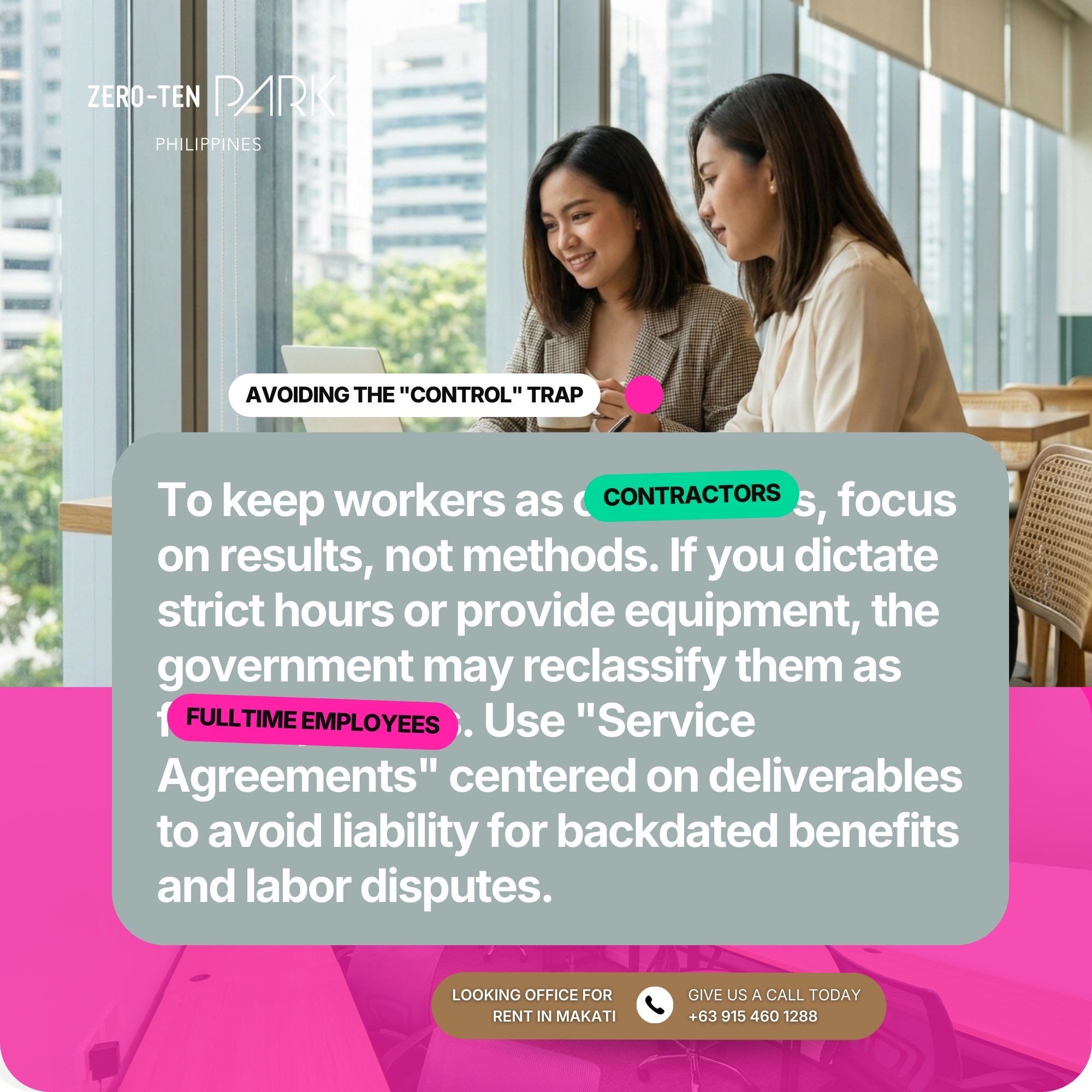
Strategic Advice: Avoiding the "Control" Trap
If you provide the laptop, set strict 9-to-5 “clock-in” times, and assign a direct supervisor who manages their minute-by-minute tasks, the Philippine government may view them as an employee. To maintain the contractor status:
- Focus on Deliverables rather than “hours worked.”
- Allow them to use their own equipment when possible.
- Use “Service Agreements” instead of “Employment Contracts.”
When you move beyond testing the waters with a few contractors and decide to build a permanent core team, you hit a crossroad: you need the stability of full-time employees, but you aren’t ready to spend $15,000 and six months to incorporate a local Philippine entity.
This is where the Employer of Record (EOR) becomes the most vital part of your Philippine Hiring Structure.
II. EMPLOYER OF RECORD (THE SCALE SOLUTION)
An EOR is a third-party service provider that becomes the “legal employer” of your staff on paper, while you remain the “operational employer” who manages their daily work, set their KPIs, and builds the culture.
Defining the Jargon
- Statutory Contributions: These are the three government-mandated funds every employee must be enrolled in: SSS (Social Security), PhilHealth (Health Insurance), and Pag-IBIG (Home Development Mutual Fund).
- 13th-Month Pay: A mandatory benefit equivalent to one-twelfth ($1/12$) of the employee’s basic salary within a calendar year, which must be paid by December 24.
- Permanent Establishment (PE) Risk: The legal danger of a foreign company being deemed to have a “taxable presence” in the Philippines because it has employees there. Using an EOR mitigates this because the EOR, a local entity, handles the tax nexus.
The “Benefit Surge”
As of 2025, the cost of labor in the Philippines has seen its most significant adjustment in years. For a startup founder, the EOR model is no longer just about convenience; it is about risk displacement in a shifting economy.
- The 15% SSS Milestone
Under the Social Security Act of 2018, 2025 marks the final scheduled increase in SSS contribution rates, now hitting 15% (split between employer and employee). Manually calculating these tiered contributions across a growing team is a high-error task. An EOR automates this, ensuring you don’t face the steep 2025 penalties for late remittances, which can reach 2% per month.
- PhilHealth & Universal Healthcare Adjustments
In 2025, PhilHealth premium rates have been finalized at 5% of the monthly basic salary (with a cap at ₱100,000). For founders hiring high-level backend developers or senior admins, this means your “on-cost” (the cost of employment above the base salary) has increased. A professional EOR provides a transparent “cost-of-hire” calculator so you aren’t blindsided by these statutory hikes when your invoice arrives.
- The Telecommuting Act (Hybrid Compliance)
The Philippine government recently updated the Telecommuting Act to formalize remote work standards. In 2026, if your team works from home, you are legally required to provide “fair treatment” regarding equipment and telecommunications costs. EORs now offer “allowance management” to compliantly reimburse your team for internet and electricity—often as tax-exempt de minimis benefits—keeping your team happy and your startup compliant.
Why Founders Choose This
The EOR model is the “plug-and-play” version of global expansion. While you pay a management fee (typically ranging from $199 to $599 per head/month), you save on the “hidden” costs of international business:
- No local bank account required: You pay the EOR in USD, SGD, or AUD; they pay the team in PHP.
- Intellectual Property (IP) Protection: Top-tier EORs use tri-party agreements that ensure all code and work product created by the Filipino employee is legally owned by your foreign startup.
- Termination Support: Unlike the US, the Philippines is not an “at-will” employment country. Terminating an employee requires “Just Cause” or “Authorized Cause.” An EOR provides the legal counsel to handle these sensitive moments without you needing to hire a local lawyer.
When you need to scale beyond a handful of people—or when your operations require high-security environments and specialized hardware—you need to look at the “hands-off” or “infrastructure-heavy” pillars of the Philippine Hiring Structure.

III. BPO AND STAFFING AGENCIES (THE MANAGED INFRASTRUCTURE)
Business Process Outsourcing (BPO) and Staffing Agencies are the traditional heavyweights of the Philippine market. Since then, however, they have evolved from simple “call centers” into high-tech partners that provide not just people, but the entire environment those people work in.
Defining the Jargon
- Managed Services: A model where the agency is responsible for the outcome (e.g., “all tickets resolved within 2 hours”) rather than just providing a person.
- Seat Leasing: A hybrid model where you provide the staff, but you rent “seats” in a professional office that comes with high-speed fiber internet, backup generators, and IT support.
- SLA (Service Level Agreement): The contractually binding performance standards the agency must meet.
- CAPEX vs. OPEX: Capital Expenditure (buying computers/office space) vs. Operational Expenditure (paying a monthly fee that covers everything). BPOs allow you to stay in the OPEX lane.
The Shift to “Premium & Secure”
The BPO landscape has shifted toward specialized Knowledge Process Outsourcing (KPO). For a founder, this model offers three distinct advantages that EORs or contractors cannot match:
- The Cybersecurity Mandate With global data privacy regulations tightening in 2025, many startups can no longer risk having backend admins work from home on personal laptops. BPOs provide “clean room” environments—office spaces where phones are prohibited and networks are SOC2 compliant. If your startup handles sensitive financial or medical data, a BPO provides the physical security layer that is legally required in many jurisdictions.
- Resilience Against “Infrastructure Fatigue” While the Philippines has made massive strides, localized power outages or internet fiber cuts still happen. BPOs are located in “PEZA” zones or prime IT parks (like BGC or IT Park Cebu) which are equipped with industrial-grade backup power and redundant internet lines. In 2025, as heatwaves have occasionally strained local power grids, BPO-based teams have maintained 99.9% uptime while home-based contractors struggled.
- “Seat Leasing” and the Return to Office (RTO) A major trend in late 2025 is the “Hybrid BPO” model. Many founders are opting for Seat Leasing, where they hire their own talent via an EOR but pay a BPO for a “managed seat.” This gives your team a professional culture and a place to collaborate 2–3 days a week, significantly reducing the “isolation attrition” that remote startups often face.
Strategic Advice: Choosing Between Staffing vs. Full BPO
- Staffing/Staff Augmentation: Best if you want to be the one managing the team’s daily tasks but want the agency to handle the office, hardware, and local HR.
- Full Managed BPO: Best if you want to “outsource the headache.” If you need a 24/7 customer support wing or a data-entry department and you don’t want to manage a single person, you hire for the result.
By leveraging a BPO or Staffing Agency, you are essentially buying a “plug-and-play” office in Manila or Cebu. It is the most expensive of the three models due to the overhead, but it is also the one that allows you to scale to 50+ people without ever having to worry about who is fixing the office router or whether the air conditioning is working.
Establishing a local entity is the most complex path, but for founders looking to truly “institutionalize” their presence in the region, it is the only way to gain 100% autonomy over every aspect of the operation.

IV. DIRECT HIRING (THE LOCAL ENTITY)
Incorporating in the Philippines used to be a months-long saga involving physical queues and stacks of notarized paper. As of late 2025, the landscape has been revolutionized by two major events:
- The “SEC ZERO” Initiative Launched at the end of 2024 and fully scaled in 2025, SEC ZERO (Zuper Easy Registration Online) has made the process almost entirely paperless. For founders, this means you can now incorporate a “Domestic Market Enterprise” digitally from your home country. The system automatically generates your Articles of Incorporation and Bylaws, and most tech-based startups can receive their digital Certificate of Incorporation in as little as 3 to 7 business days.
- The 2025 Capital Threshold Realities A critical point of confusion for many founders is the $200,000 USD minimum capital requirement. While this remains the standard for foreign-owned companies selling products inside the Philippines, there is a “Startup & Export” loophole. If your Philippine team is exclusively supporting your foreign startup (i.e., you are “exporting” services), you may qualify for the Export Market Enterprise status, which can lower your required capital to as little as ₱5,000 (~$90 USD).
- The “One Person Corporation” (OPC) Advantage For the solo founder, the OPC has become the “Gold Standard” in 2025. It offers limited liability—meaning your personal assets are protected from business debts—without the need to find local “nominee” directors who might complicate your cap table.
The “Founder’s Burden”: Ongoing Compliance
While this model removes EOR management fees, it replaces them with administrative responsibility. To stay compliant in 2026, a local entity must:
- Maintain a Local Resident Agent: A person or firm in the Philippines who can receive legal summons on your behalf.
- Appoint a Corporate Secretary: This person must be a Filipino citizen.
File Monthly Tax Returns: Even if you are just “recharging” costs from your HQ, you must file with the Bureau of Internal Revenue (BIR) every month.
Is it right for you?
Direct hiring is generally recommended only once you hit a “critical mass” of 30+ employees. At this scale, the cost of hiring a local accountant and HR manager ($1,500–$2,500/month) becomes cheaper than paying the per-head “convenience fees” charged by EORs or BPOs. It is the ultimate move for founders who want to build a “Company Culture” that feels identical to their home office.
To help you finalize your expansion strategy, the table below compares the four hiring models based on the current financial landscape.
The “Base Salary” is what the employee receives, but as a founder, you must focus on the Total Cost of Employment (TCE)—which includes the service fees, “on-costs” (taxes/benefits), and infrastructure.

PHILIPPINE HIRING STRUCTURE: COST COMPARISON
| Feature | Independent Contractor | Employer of Record (EOR) | BPO / Staffing Agency | Direct Hire (Local Entity) |
| Typical Service Fee | $0 (Direct payment) | $190 – $599 / month per head | $300 – $800+ / month per head | $0 (In-house HR/Legal cost) |
| Statutory On-Costs | 0% (Handled by worker) | ~12% – 15% of salary | Included in monthly bill | ~12% – 15% of salary |
| 13th Month Pay | Not mandatory (but common) | Mandatory (1/12 of salary) | Included in monthly bill | Mandatory (1/12 of salary) |
| Infrastructure | Worker provides own | Worker provides own | Included (Office, PC, IT) | You provide (CAPEX) |
| Setup Cost | $0 | $0 – $250 (One-time) | $500 – $1,500 (Setup fee) | $3,000 – $10,000+ (Legal/SEC) |
| Speed to Hire | 1–3 Days | 2–10 Days | 2–4 Weeks | 3–6 Months (for entity) |
Detailed Cost Breakdown & Terminology
- Statutory On-Costs: These are the mandatory employer shares for SSS, PhilHealth, and Pag-IBIG. In 2025, the total employer contribution is roughly 12-15% of the gross salary.
- Management/Service Fee: This is the “convenience tax” you pay the provider to handle compliance. Local-first EORs often charge a flat $190 USD, while global platforms like Deel or Remote often start at $599 USD.
- Infrastructure (CAPEX vs. OPEX):
- With Contractors/EOR, the worker usually works from home. You might send them a one-time “Equipment Allowance” ($800–$1,200).
- With a BPO, you pay a monthly Seat Lease (approx. $250–$400/seat), which covers high-speed fiber, backup generators (critical in PH), and hardware.
- Direct Hire “Hidden” Costs: While you save on monthly service fees, you must budget for a Local Resident Agent (~$1,700/year), a Corporate Secretary (~$2,500/year), and a monthly Accounting/Tax Filing service (~$300/month) to stay compliant with the SEC and BIR.
Founder’s Summary: When to Switch?
- Phase 1 (Agile): 1–3 people? Use Contractors. Highest speed, lowest cost, but higher “churn” risk.
- Phase 2 (Growth): 3–30 people? Use an EOR. It protects your IP and keeps you legal without the paperwork of a local office.
- Phase 3 (Stability): 30+ people? Use a BPO/Seat Leasing if you want them in an office, or move to a Local Entity if you want to eliminate the $400/head EOR fee and build a “forever” team.
To help you finalize your strategy, the following projection models the first-year costs for a core team of 5 Backend Admins.
In the Philippines, “Backend Admin” is a mid-level role that typically commands a monthly base salary of $1,000 to $1,500 USD (approx. ₱58,000–₱87,000) for those with 3+ years of experience. For this exercise, we will use a $1,200 monthly base salary as the benchmark.
12-Month Budget Projection: Team of 5 (Total Annual Spend)
| Cost Component | EOR Model (Remote) | BPO Model (Managed Office) |
| Total Base Salaries (5 x $1,200 x 12) | $72,000 | $72,000 |
| 13th Month Pay (Mandatory) | $6,000 | Included in monthly bill |
| Statutory On-Costs (SSS, PhilHealth, Pag-IBIG) | ~$8,640 (12%) | Included in monthly bill |
| Monthly Management Fee | ~$11,400 ($190/mo/head) | ~$24,000 ($400/mo/head) |
| One-Time Setup / Equipment | $5,000 ($1k/head laptop/desk) | $0 (BPO provides hardware) |
| ESTIMATED ANNUAL TOTAL | $103,040 | $96,000 |
| Estimated Monthly “All-In” Per Head | $1,717 | $1,600 |
Building a team in the Philippines is one of the most effective levers a startup founder can pull to extend runway without sacrificing talent quality. Whether you start with the agility of Independent Contractors, the compliance of an EOR, the infrastructure of a BPO, or the long-term equity of a Local Entity, the key is to match your hiring structure to your stage of growth.
In 2026, the “Philippine Hiring Structure” has never been more accessible or digitally streamlined. By staying aware of the 13th-month requirements and the rising statutory caps, you can build a backend operation that doesn’t just cut costs—it becomes a competitive advantage for your global operations.
✨ HOW ZERO-TEN PARK (THE COMPANY) ACCELERATES YOUR GROWTH
- Integrated EOR Services: Hire in days with in-house Employer of Record solutions starting at ~₱8,000/month. They manage the full 2026 compliance stack, including SSS, PhilHealth, Pag-IBIG, and mandatory 13th-month pay.
- Asset-Light Infrastructure: Skip expensive fit-outs and deposits. Flexible “Build-to-Suit” offices convert heavy CAPEX into 100% tax-deductible OPEX, preserving capital for your core product.
- The Global Corridor: Leverage specialized bilingual support and a “Global Passport” system, providing seamless access to partner hubs in Fukuoka, Tokyo, Singapore, and Hawaii.
- Strategic Incubation: Access a proactive business-matching engine for direct introductions to local legal experts, tax consultants, and regional venture capital networks.
Many startups use Zero-Ten Park for “Anchor Days.” Even with a remote EOR team, renting a dedicated “Team Room” for 1–2 days a week ensures a high-security, fiber-powered environment for critical sprints while fostering a face-to-face company culture.
FREQUENTLY ASKED QUESTIONS
No. In the Philippines, the 13th-month pay is a legally mandated benefit, not a discretionary bonus. By law, it must be paid to all rank-and-file employees on or before December 24th. It is calculated as 1/12 of the employee’s total basic salary earned during the calendar year. Failing to pay this is one of the fastest ways to trigger a Department of Labor (DOLE) audit.
Philippine law generally favors the creator unless a “Work for Hire” or “Assignment of Invention” clause is explicitly signed. If you use the Independent Contractor model, you must ensure your service agreement specifically states that all IP is transferred to your company upon creation. If using an EOR, the tri-party agreement handles this by assigning rights from the employee to the EOR, and then to your startup.
The Control Test is the legal benchmark used by Philippine courts to determine if a worker is a contractor or a de facto employee. If you dictate the exact “how, when, and where” of their work (e.g., specific software, rigid 9-to-5 monitoring, and direct supervision of methods), they may be reclassified as an employee. This would make you liable for backdated taxes and mandatory benefits.
While you can agree on a salary in foreign currency, it is highly recommended to pay the equivalent in Philippine Pesos (PHP). Under 2026 tax regulations, local banks and e-wallets like GCash are more scrutinized for “unregistered” foreign inflows. Paying in PHP via an EOR or local entity ensures the team receives a stable amount and stays compliant with the Bureau of Internal Revenue (BIR).
Unlike “at-will” employment in the US, the Philippines follows a “Just Cause” and “Authorized Cause” framework. You cannot fire someone without a documented legal reason (e.g., serious misconduct or redundancy) and a specific “Two-Notice Rule” process. This is why many founders prefer the EOR or BPO models, as these partners provide the legal expertise to handle terminations without exposing the founder to litigation.

GET A QUOTE TODAY
"*" indicates required fields
Ready to level up your business presence and save more every month? Complete the form now and our team will handle the rest.