

Building Remote Philippine Teams: The Full Guide to Direct Hiring and Entity Setup in the Philippines

Somewhere between your third contractor ghosting incident and your fifth attempt at deciphering Philippine labor law, you probably wondered if there was a more straightforward path forward.
There is. But the internet hasn’t done a great job explaining it.
Most guides on Philippine expansion fall into two camps: high-altitude overviews that sound reasonable but leave you no closer to actual execution, or thinly veiled sales pitches dressed up as educational content. Neither serves you well when you’re sitting in Singapore or Sydney or San Francisco trying to figure out how to build a real team in Manila without accidentally creating a compliance nightmare or burning through six months of runway.
This guide exists because we’ve spent eight years watching companies attempt this exact thing. Some succeeded brilliantly. Many retreated quietly within 18 months. The difference rarely came down to budget or business model—it came down to understanding how the system actually works before stepping into it.
What follows is the operational playbook: registration sequences, real timelines, actual costs, common failure points, and decision frameworks for determining whether direct hiring, entity formation, or some hybrid approach makes sense for your specific situation. No gatekeeping. No “contact us to learn more” dead ends.
One caveat before we begin: this guide is designed for operators ready to commit to a genuine Philippine presence—companies that see the market as a strategic asset rather than a cost-cutting experiment. If you’re exploring whether the Philippines might possibly work for you someday, this level of detail will feel overwhelming. Come back when you’re ready to build.
WHO THIS GUIDE SERVES (AND WHO IT DOESN'T)
Direct hiring and entity setup in the Philippines represents a significant commitment. Before diving into mechanics, let’s establish whether this path makes sense for you.
This approach works well for:
Foreign startups and scale-ups with at least five Philippine-based roles planned over the next 12-18 months. Companies headquartered in the United States, United Kingdom, Australia, or Singapore looking to establish APAC operational capacity. Organisations that have outgrown the EOR model economically or operationally. Teams seeking deep integration with local talent rather than arm’s-length contractor relationships. Companies that need their Philippine operations to feel like an extension of headquarters, not an outsourced function.
This approach typically fails for:
Companies testing the Philippine market with one or two hires. Organisations without internal capacity to manage compliance and HR functions. Teams expecting instant results without cultural adaptation. Companies viewing this purely as a cost arbitrage play with no long-term operational strategy.
The distinction matters because direct hiring and entity setup carries upfront costs—financial, operational, and managerial—that only pay off at sufficient scale. A company hiring two developers for six months has no business setting up a Philippine corporation. A company planning to build a 15-person product team over the next two years almost certainly does.
THE FOUR PATHS INTO PHILIPPINE OPERATIONS
Before examining entity setup specifically, you need to understand where it sits among your options. Foreign companies entering the Philippine market typically choose from four structures, each with distinct implications for cost, control, speed, and risk.
Path One: Independent Contractors
The most common starting point. You find talent, agree on deliverables, pay invoices, and avoid the complexities of employment law entirely.
This works until it doesn’t.
Philippine labor regulations—like those in most jurisdictions—distinguish between genuine independent contractors and misclassified employees. The test isn’t what you call the relationship but how it functions in practice. If you control when, where, and how the work gets done, if the person works exclusively or primarily for you, if the engagement is ongoing rather than project-based, you’ve likely created an employment relationship regardless of contract language.
The Bureau of Internal Revenue and Department of Labor have become increasingly aggressive about contractor misclassification. The risks include back taxes, penalties, mandatory employee benefits owed retroactively, and potential business registration issues. For one or two genuine project-based contractors, this structure makes sense. For ongoing operational roles, it’s a liability waiting to materialise.
Path Two: Employer of Record (EOR)
EOR platforms like Deel, Remote, or Oyster employ your team members on paper while you direct their daily work. The EOR handles payroll, taxes, benefits, and compliance. You pay a per-employee fee plus the fully-loaded salary costs.
This model has real advantages. Speed to hire is measured in days rather than months. Compliance risk transfers to a third party. No capital requirement, no local entity, no need to understand Philippine corporate law.
The economics work well at small scale. When you’re hiring three to five people to test the market, EOR fees represent a reasonable cost of de-risking. The problems emerge as you scale.
Most EOR platforms charge $400-800 per employee per month. At ten employees, you’re paying $4,000-8,000 monthly just in platform fees—before salaries, benefits, or any other costs. At twenty employees, you’re spending $96,000-192,000 annually on what is essentially administrative overhead.
Run that calculation forward two or three years and the numbers become difficult to justify. Which brings us to path three.
Path Three: Representative Office
A representative office is a registered presence in the Philippines that cannot engage in revenue-generating activities or hire employees for operational roles. It exists solely to liaise with headquarters, gather market intelligence, conduct quality control, and coordinate with suppliers or partners.
For companies whose Philippine operations genuinely fit that description—say, a manufacturer coordinating with local suppliers without selling in-country—this structure offers simplicity. Registration is straightforward, capitalisation requirements are minimal, and ongoing compliance is manageable.
The limitation is structural: you cannot employ people to do actual work beyond coordination functions. If your plan involves building a development team, a support operation, or any revenue-generating capacity, the representative office model doesn’t apply.
Path Four: Fully Owned Entity
This is what most companies mean when they discuss “setting up in the Philippines.” You register a corporation under Philippine law, either as a branch of your foreign parent company or as a domestically incorporated subsidiary. This entity becomes the legal employer of your Philippine team, subject to all relevant labour regulations, tax obligations, and compliance requirements.
The tradeoffs are the inverse of the EOR model: higher upfront cost and complexity, but dramatically better economics at scale. Entity formation requires capital commitment, legal work, and three to six months of setup time. Once operational, your per-employee overhead drops to a fraction of EOR fees—typically $50-150 per head for ongoing compliance and administration, depending on complexity.
For companies planning to build substantial Philippine operations over multi-year horizons, entity setup is almost always the economically rational choice. The question is whether you’re ready to make that commitment and whether you have the operational capacity to manage it properly.
THE DIRECT HIRING DECISION: WHEN ENTITY SETUP MAKES SENSE
The right structure depends on where you are today and where you’re heading over the next 18-36 months. Here’s a framework for thinking through the decision.
Stay With EOR If:
Your Philippine headcount will remain under eight people for the foreseeable future. You’re testing the market and haven’t committed to long-term presence. Your company lacks internal capacity to manage a foreign subsidiary’s compliance and HR requirements. Speed matters more than cost optimisation.
Transition to Entity When:
You have or expect to have more than eight Philippine employees within 12-18 months. The EOR cost structure has become a material line item in your operating budget. You want deeper control over employment terms, compensation structures, and workplace culture. Your business model requires local corporate presence—for contracts, banking relationships, or customer-facing operations. You’re planning significant capital investment in Philippine infrastructure (office space, equipment, local partnerships).
The Inflection Point
Most companies find the entity setup discussion becomes unavoidable somewhere between eight and fifteen employees. Below that threshold, EOR platform fees are irritating but tolerable. Above it, you’re sending substantial money to intermediaries for services you could handle directly at lower cost.
There’s a second inflection point around employee tenure. If your Philippine team consists primarily of short-term contractors rotating through, the flexibility of EOR arrangements has value. If you’re building teams that will stay for years, investing in proper infrastructure makes more sense. The math changes when you factor in the cultural and retention benefits of employees who work for your actual company rather than a staffing platform.
ENTITY SETUP IN THE PHILIPPINES: THE COMPLETE PROCESS
Assuming you’ve determined that direct hiring through your own entity makes sense, here’s how the process actually works. We’ll walk through both the branch office and domestic corporation routes, noting where they diverge.
Choosing Your Entity Type
Branch Office of Foreign Corporation
Your parent company extends itself into the Philippines. The branch isn’t a separate legal entity—it’s a registered presence of the foreign corporation. Profits, losses, and liabilities flow directly to the parent.
Advantages: Simpler governance structure, no requirement for local shareholders or directors, straightforward profit repatriation. Works well when you want clear integration between Philippine operations and headquarters.
Disadvantages: Parent company is fully liable for branch obligations. Some activities may require Securities and Exchange Commission (SEC) pre-approval. Can be more complex to dissolve if you later exit the market.
Domestic Subsidiary (Philippine Corporation)
You incorporate a new company under Philippine law. The subsidiary is its own legal entity, owned by your parent company but legally distinct.
Advantages: Limited liability—parent company exposure is generally capped at investment amount. More flexibility in structuring, potentially easier to sell or spin off later.
Disadvantages: Requires at least two shareholders and board of directors (can be nominees but adds complexity). More formal governance requirements. Dividend distribution requires board approval and may carry tax implications.
For most foreign companies building operational teams, the choice between branch and subsidiary has modest practical impact. The branch route is slightly simpler for pure operations; the subsidiary route offers slightly more flexibility for complex structures or future transactions. Neither is clearly superior in general terms.
Step One: Securing SEC Registration
The Securities and Exchange Commission is your starting point regardless of entity type. This is where your Philippine legal existence begins.
For a Branch Office:
You’ll need to submit: authenticated copies of your parent company’s articles of incorporation and bylaws, board resolution authorising the Philippine branch establishment, audited financial statements of the parent company (typically two years), the proposed branch’s articles of incorporation and bylaws, and proof of inward remittance for capitalisation.
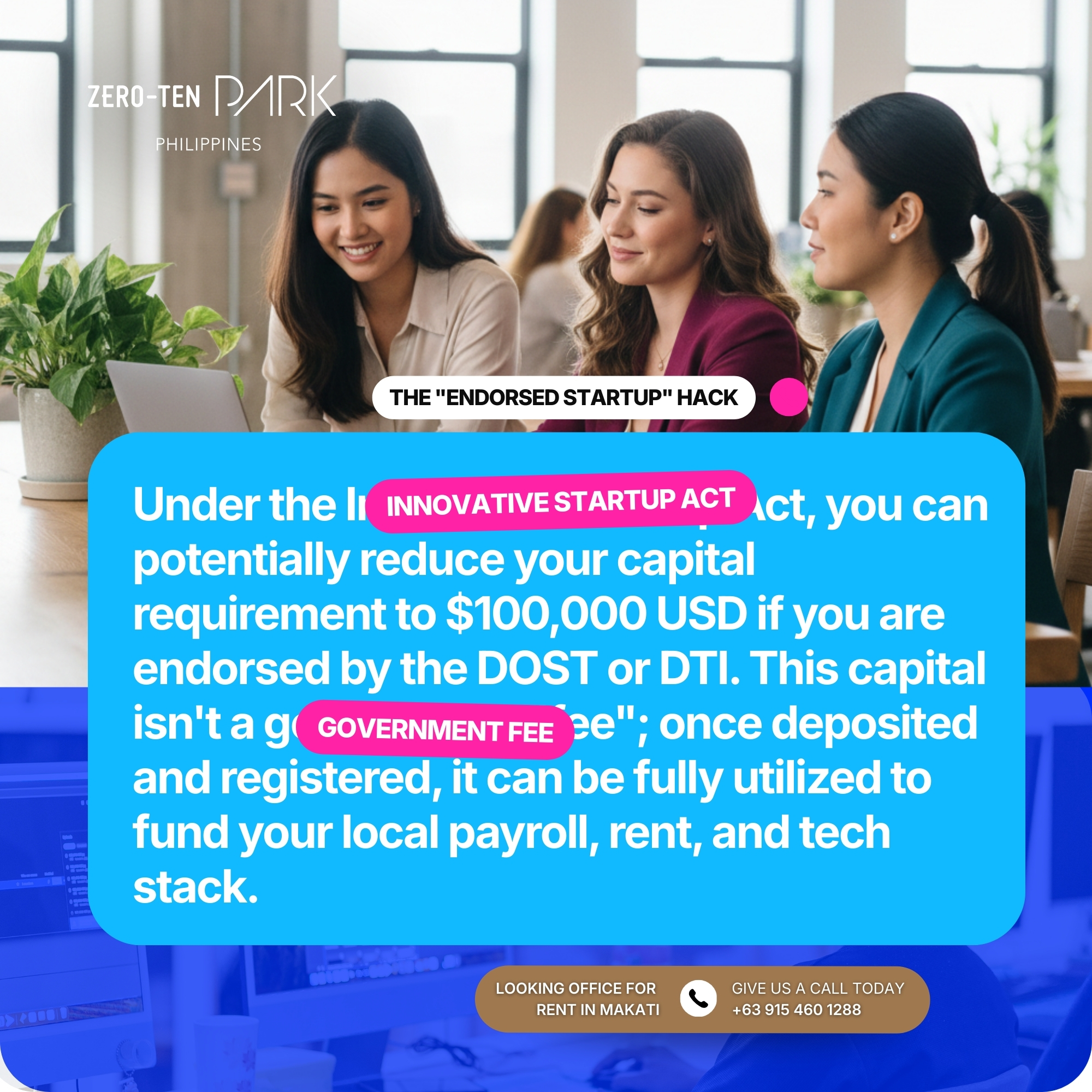
The minimum capital requirement for most foreign branches is $200,000 USD, though certain activities in the Investment Priorities Plan may qualify for reduced requirements. If you’re exporting 100% of output or your operation involves advanced technology transfer, lower thresholds may apply.
Processing time: 30-60 days once documents are complete and authenticated.
For a Domestic Corporation:
You’ll file articles of incorporation and bylaws with the SEC, along with treasurer’s affidavit confirming initial capital subscription payment. Foreign-owned corporations generally require minimum paid-up capital of $200,000 USD, with the same potential reductions for export-oriented or technology-focused operations.
Processing time: 15-30 days for standard applications.
Step Two: Local Government Registration
Once SEC registration is complete, you’ll register with the local government unit (LGU) where your principal office will be located. In Metro Manila, this typically means the city government—Makati, Taguig, Quezon City, or wherever you establish headquarters.
This process secures your Mayor’s Permit (business permit), which is renewed annually. Requirements include your SEC registration, lease contract for office space, and various clearances depending on location. Some LGUs require fire safety inspection, sanitation clearance, or building permit verification.
Processing time: 15-30 days, though this varies significantly by municipality. Some LGUs have streamlined processes; others involve considerable bureaucratic navigation.
Step Three: Bureau of Internal Revenue Registration
Your BIR registration establishes your Tax Identification Number (TIN) for the corporation and registers you for various tax obligations: income tax, withholding tax on employee compensation, expanded withholding tax on payments to contractors and suppliers, value-added tax or percentage tax depending on gross receipts.
This stage also involves registering your books of accounts and official receipts or invoices with the BIR.
Processing time: 7-15 days.
Step Four: Social Security and Benefits Registration
As an employer, you must register with three agencies:
Social Security System (SSS): Mandatory retirement, disability, and death benefits for employees. Both employer and employee contribute monthly based on salary brackets.
Philippine Health Insurance Corporation (PhilHealth): Mandatory health insurance. Again, joint employer-employee contributions.
Home Development Mutual Fund (Pag-IBIG): Housing savings fund. Joint contributions with certain loan benefits for employees.
Each registration requires your SEC and BIR documentation plus designated forms. Total processing time: 7-15 days if handled concurrently.
Step Five: Department of Labor and Employment
Register your company with DOLE’s Regional Office. This establishes your presence for labour law compliance purposes and is required before you can legally employ workers.
Processing time: Same-day to 7 days.
The Full Timeline: Realistic Expectations
Start to finish, entity setup typically requires three to six months assuming:
- Your parent company documents are in order and can be authenticated without complications
- Capital transfer mechanisms work smoothly
- You have competent local legal and accounting support
- No unusual issues arise with any registration
Plan for the longer end of that range. The Philippines operates on relationships and paper processes, and things simply take time. Companies that budget three months and hit complications at month two face difficult decisions about whether to proceed or cut losses.
CAPITAL REQUIREMENTS AND FUNDING MECHANICS
The $200,000 minimum paid-up capital requirement deserves closer examination, as it represents a significant barrier for smaller companies.
Understanding the Requirement
This capital must be:
- Actually transferred into the Philippines (not just pledged)
- Deposited in a local bank account under the company’s name
- Certified by the bank as received from foreign sources
The capital becomes working capital for your Philippine operations—you can use it to pay salaries, rent, equipment, and operating expenses. It’s not locked away or inaccessible.
Reduced Capital Thresholds
Certain categories of foreign investment qualify for reduced capitalisation:
Export enterprises: Companies that will export at least 60% of output may qualify for $100,000 minimum capital.
Advanced technology enterprises: Operations involving technology transfer or specialised know-how that doesn’t exist domestically may qualify for similar reductions.
Small and medium domestic market enterprises: There are provisions for lower capital requirements in certain sectors, though these are more complex to navigate and may not apply to typical tech or services operations.
Practical Capital Considerations
Beyond minimum requirements, think about actual operating capital needs. You’ll need funds for:
- Office lease deposits (typically 2-3 months advance plus security)
- Initial payroll runway (3-6 months of fully-loaded labour costs)
- Equipment and infrastructure
- Legal, accounting, and compliance professional fees
- Contingency for unexpected delays or costs
A company entering with exactly $200,000 and planning to spend most of it immediately will find cash management stressful. Build appropriate buffer into your capitalisation planning.
BUILDING YOUR LOCAL TEAM: PHILIPPINE LABOUR LAW FUNDAMENTALS
Once your entity exists, you become an employer subject to Philippine labour regulations. Understanding the framework prevents costly mistakes.
Employment Contracts
Philippine law distinguishes between regular employment and various fixed-term or project-based arrangements. Most companies building operational teams will hire regular employees, which triggers specific rights and protections.
Employment contracts must specify: job description and duties, compensation and benefits, work schedule, and terms of employment. Written contracts aren’t strictly required for regular employment (verbal agreements can be enforceable), but operating without written documentation creates enormous downstream risk.
Compensation Structure
The Philippine compensation landscape involves:
Basic salary: Your headline number, subject to minimum wage laws that vary by region. Metro Manila currently has the highest minimums at around PHP 610 daily for non-agricultural work.
13th month pay: Mandatory additional compensation equal to one month’s basic salary, paid no later than December 24 each year. This isn’t a bonus—it’s required by law.
Statutory benefits: Employer contributions to SSS, PhilHealth, and Pag-IBIG as described earlier. Budget approximately 10-12% of basic salary for these employer-side contributions.
Leave entitlements: Employees with one year of service are entitled to five days of service incentive leave annually. Most employers offer additional vacation and sick leave as part of competitive packages.
Overtime: Work beyond eight hours daily or on rest days and holidays carries premium rates ranging from 25% to 100%+ of regular pay depending on circumstances.
Typical Compensation Packages
For skilled knowledge workers in Metro Manila—developers, designers, customer success managers, operations specialists—competitive monthly salaries typically range from PHP 40,000 to PHP 150,000 depending on experience and specialisation. That’s roughly $700 to $2,700 USD at current exchange rates.
Fully loaded costs (salary plus benefits plus employer taxes) typically run 15-25% above basic salary, depending on your benefits structure.
Termination Realities
This is where many foreign employers encounter friction. Philippine labour law strongly favours employee tenure and imposes strict requirements for lawful termination.
Just causes: Serious misconduct, fraud, wilful disobedience, gross negligence, or commission of a crime against the employer or co-workers. Even with just cause, you must follow due process: written notice, opportunity to explain, and hearing before termination takes effect.
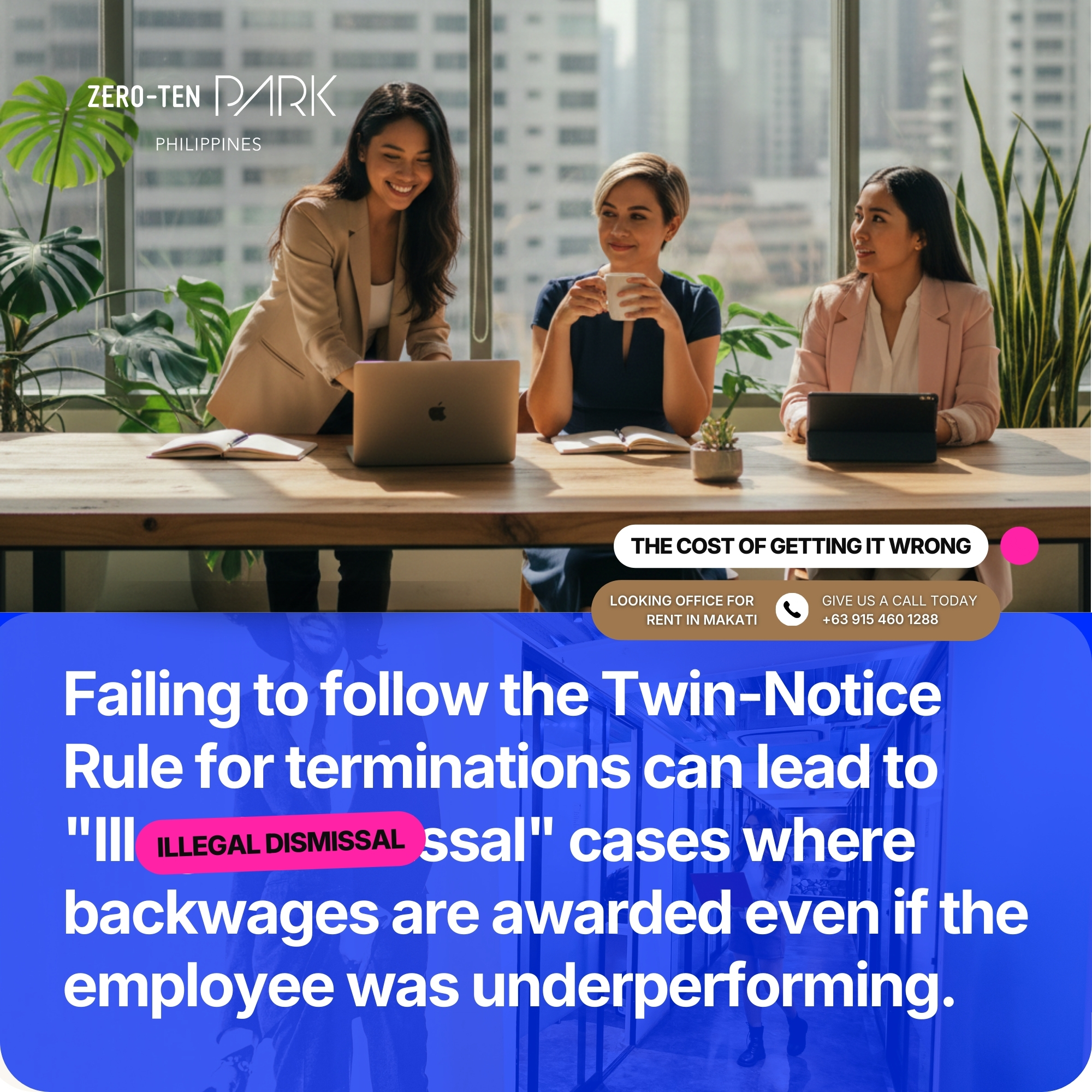
Authorised causes: Business closure, redundancy, retrenchment due to financial losses, or installation of labour-saving devices. These require 30 days advance notice to both the employee and DOLE, plus separation pay (typically one month per year of service, though the calculation varies).
What’s not grounds for termination: Poor culture fit. Personality conflicts. Vague underperformance without documented coaching and improvement opportunities. Restructuring that eliminates a role without genuine business justification.
The practical implication: your hiring process must be rigorous because unwinding a bad hire is expensive, time-consuming, and legally constrained. Companies accustomed to at-will employment environments need significant adjustment in their approach.
Probationary Employment
Philippine law permits probationary periods of up to six months. During probation, employees can be terminated for failure to meet reasonable standards—but only if those standards were clearly communicated at the time of hiring and fairly applied.
This six-month window is critical. Use it to genuinely evaluate fit, not just to delay benefits. If an employee isn’t working out, make the determination before probation ends. Once an employee regularises, termination becomes substantially more complex.
COMPLIANCE LANDSCAPE: ONGOING OBLIGATIONS
Entity setup is the beginning, not the end, of your compliance journey. Running a Philippine operation requires ongoing attention to several regulatory streams.
Tax Compliance
Monthly obligations: Withholding taxes on compensation (due 10th-15th of following month), expanded withholding taxes on payments to suppliers and contractors, VAT or percentage tax returns.
Quarterly obligations: Corporate income tax estimates (quarterly returns filed in April, July, October, with annual return in April).
Annual obligations: Annual income tax return, information returns detailing all compensation paid, annual registration fee renewal with BIR.
The penalties for non-compliance aren’t trivial. Interest, surcharges, and potential criminal liability for responsible officers make tax compliance non-negotiable.
Labour Compliance
Payroll records: Maintain complete records of all compensation, deductions, and benefits for all employees. DOLE and SSS audits do happen.
Working time records: Document hours worked, overtime, and leave utilisation.
Employee reporting: Various reports to SSS, PhilHealth, and Pag-IBIG on contributions, changes in employment status, and separations.
Safety and health: Depending on your industry, various occupational safety requirements may apply. Even office-based operations have basic compliance requirements.
Corporate Governance
Annual stockholders meeting: Required for domestic corporations.
Board meetings: Documented quarterly (domestic corporation) or as required by your parent company’s governance structure (branch).
Financial statements: Annual audited financial statements filed with SEC.
General information sheet: Annual filing with SEC updating corporate officers, directors, stockholders, and other details.
THE COST OF GETTING IT WRONG
Companies that underinvest in compliance infrastructure tend to discover problems when they’re most inconvenient: during a transaction, during an audit, when terminating a problematic employee, or when a departing worker files a complaint.
The time to establish proper systems is at formation, not after you’ve accumulated two years of sloppy records. Budget for competent local accounting and legal support. This is not where you economise.
OFFICE AND INFRASTRUCTURE CONSIDERATIONS
With your entity established and compliance framework in place, you need somewhere for your team to work.
Metro Manila Geography
Most foreign companies establish headquarters in Metro Manila, specifically in the major business districts:
Makati Central Business District: The traditional financial and commercial centre. Dense concentration of multinational offices, professional services firms, banks, and high-end commercial real estate. Premium pricing reflects the location prestige.
Bonifacio Global City (Taguig): Newer, more modern development with significant tech company presence. Lower density than Makati, more contemporary building stock. Increasingly the default choice for tech operations and startups.
Ortigas Center: Older business district, generally lower cost than Makati or BGC. Strong BPO presence. Practical choice for operations-focused companies less concerned with premium positioning.
Quezon City: Largest city in Metro Manila by population, with emerging business districts near major universities. Talent pool access is strong; commercial real estate options are expanding. Considerably less expensive than Makati or BGC.
Your location choice affects talent recruitment, commute burdens for employees, and (to some degree) how partners and clients perceive your operation.
Real Estate Models
Traditional lease: You sign a multi-year lease for dedicated space, build it out to your specifications, and manage all facilities yourself. Maximum control, maximum commitment, maximum fixed cost.
Serviced offices: Move-in ready space with shared reception, meeting rooms, and administrative services. Higher per-desk cost than traditional leases but much lower commitment. Good for establishing presence quickly or when headcount projections are uncertain.
Coworking spaces: Even lower commitment than serviced offices, with complete flexibility to scale up or down. Less private, less customised, but minimal fixed overhead. Many foreign companies start here while entity setup proceeds, then transition to dedicated space once operations stabilise.
Hybrid arrangements: Start in flexible space, graduate to dedicated space as team size justifies the commitment. This staged approach reduces upfront capital requirements and allows you to learn local preferences before making long-term real estate decisions.
IT and Communications Infrastructure
Philippine internet connectivity has improved dramatically over the past decade but remains variable. In major business districts, reliable enterprise-grade connectivity is available. Outside those areas, quality can be inconsistent.
For remote work scenarios: most Philippine professionals have acceptable home internet, but investing in backup connectivity (mobile data allowances, coworking space access for important meetings) reduces disruption risk.
Mobile communications are reliable and inexpensive. The Philippines operates on global GSM standards.
COMMON FAILURE PATTERNS AND HOW TO AVOID THEM
After eight years of watching companies attempt Philippine expansion, certain patterns emerge consistently among those that struggle or fail.
Failure Pattern One: Underestimating Setup Time
The most common miscalculation is timeline optimism. A company announces plans to have a Manila office operational by Q3, begins entity setup in Q2, and finds themselves still waiting on SEC registration when the deadline passes.
The fix: Add 50% to whatever timeline you think is reasonable. Staff your first hires through EOR arrangements while entity setup proceeds. Don’t make operational commitments that depend on registration completing on schedule.
Failure Pattern Two: Hiring Too Fast
Enthusiasm about labour cost arbitrage leads to rapid headcount expansion before management capacity exists to integrate those hires effectively. Six months later, half the team is unproductive, culture is fragmented, and the company is worse off than if they’d hired three people and done it properly.
The fix: Sequence hiring to management capacity. Your first local hires should include at least one person capable of serving as a management bridge—someone who understands both your company culture and Philippine working norms. Don’t scale past what you can actually supervise.
Failure Pattern Three: Compensation Race to the Bottom
Some companies enter the Philippines with aggressive cost targets that translate into below-market compensation. They attract candidates who can’t get offers elsewhere—and learn why those candidates were available.
The fix: Understand what competitive looks like in your specific talent market. Philippine labour costs are lower than developed markets, but the best local talent has options. Paying at the 25th percentile attracts 25th percentile talent. Modest premiums to market rates buy disproportionate quality and retention advantages.
Failure Pattern Four: Assuming Identical Work Norms
Direct transplantation of American or European management approaches without adaptation creates friction. Communication styles, feedback expectations, hierarchy norms, and conflict resolution patterns differ.
This doesn’t mean Philippine workers are difficult to manage—it means effective management requires understanding context.
The fix: Invest in cross-cultural awareness, especially for anyone with direct reports in Manila. Understand that indirect communication isn’t evasion; reluctance to contradict authority isn’t lack of initiative; relationship-building time isn’t inefficiency. Build management practices that work bidirectionally.
Failure Pattern Five: Compliance Corners
Cash-strapped or administratively overwhelmed companies defer compliance tasks: late tax filings, incomplete employment records, informal contractor arrangements for roles that are clearly employment relationships.
Problems compound quietly until they don’t. An audit. A disgruntled employee. A potential acquirer’s due diligence. Suddenly deferred problems become expensive emergencies.
The fix: Build compliance costs and processes into operations from day one. This isn’t overhead—it’s the price of doing business legally. Companies that can’t afford proper compliance can’t afford to operate in the market.
THE HYBRID PATH: BRIDGING EOR AND ENTITY
For companies not ready to commit fully to entity setup but uncomfortable with indefinite EOR dependency, hybrid approaches offer middle ground.
Starting With EOR, Transitioning to Entity
Begin hiring through an EOR platform while simultaneously initiating entity registration. Once your entity is operational—typically 4-6 months—transition existing team members from the EOR’s employment to yours.
This approach sacrifices some cost efficiency (you’re paying EOR fees during the transition period) but gains speed to market. Your team is building while paperwork processes.
Implementation notes: Ensure your EOR contract permits clean employee transfers. Some platforms have restrictive terms around taking “their” employees. Clarify this before signing.
Maintained Hybrid Operations
Some companies use both structures permanently: entity-employed core team plus EOR-based staff for roles where flexibility matters more than cost optimisation. Seasonal capacity, project-based specialists, or roles with high turnover might remain on EOR arrangements while stable operational functions move to direct employment.
When this makes sense: When a portion of your workforce genuinely needs flexibility (contractors, part-time arrangements, trial hires) while the majority benefits from full integration.
Partnership-Based Approaches
Rather than building all infrastructure internally, some companies partner with established Philippine operators who provide shared services: HR administration, compliance management, facilities, and local business support.
This model sits between full EOR dependency and fully internal operations. You maintain your own entity and directly employ your team, but outsource administrative complexity to specialists. Costs fall between EOR platform fees and fully internal operations.
When this makes sense: When you want entity control and direct employment but lack internal capacity for full compliance and HR administration. Works best with partners who have genuine operational depth rather than just administrative services.
MAKING THE DECISION: A FRAMEWORK
Pull together everything above into a practical decision process:
Step One: Clarify Your Time Horizon
Are you testing the Philippine market or committing to multi-year presence? Testing suggests EOR. Committing suggests entity.
Step Two: Project Your Scale
Map expected headcount over 18-36 months. Under eight employees: EOR economics are tolerable. Eight to fifteen: the entity conversation becomes relevant. Over fifteen: entity setup is almost certainly correct economically.
Step Three: Assess Internal Capacity
Do you have (or will you hire) someone capable of managing foreign subsidiary compliance and HR functions? If not, factor that cost into your planning—either as a hire or as outsourced professional services.
Step Four: Calculate True Costs
Compare scenarios:
- Scenario A: Remain on EOR for 36 months. Calculate total platform fees at projected headcount trajectory.
- Scenario B: Entity setup plus ongoing compliance costs. Include setup costs, capital commitment, and monthly operating overhead.
The break-even point is typically somewhere between 12-24 months for companies with meaningful headcount growth.
Step Five: Evaluate Strategic Factors
Beyond economics, consider:
- Do you need local corporate identity for contracts or customer relationships?
- Will employees integrate better if they work for your actual company?
- Does your industry have specific requirements around local presence?
- Are there grants, incentives, or market access benefits that require registered entity status?
Step Six: Decide and Execute
If entity setup is the answer, move deliberately:
- Engage competent local legal and accounting partners
- Begin documentation authentication process (this takes time)
- Start hiring through EOR to build team while registration proceeds
- Plan transition timeline with appropriate buffers
If EOR remains the right choice for now, establish clear triggers that would prompt reconsideration: headcount thresholds, cost thresholds, operational milestones.
WHAT HAPPENS IF YOU DON'T ACT
We promised to address downstream consequences. Here’s the reality for companies that remain stuck—not deciding, not acting, watching competitors establish Philippine presence while they deliberate.
The talent arbitrage window narrows. The Philippines produces roughly 700,000 university graduates annually, many with strong English proficiency and technical skills. That sounds like an infinite talent pool—until you recognise that the best graduates get absorbed quickly. Companies that establish employer brand recognition early lock in recruitment advantages. Those arriving later compete for the same candidates but with less reputation leverage.
Scaling costs compound. Every month you remain in high-cost markets for talent that could be sourced locally, you burn capital that compounds into real strategic disadvantage. The competitor who built a Manila team two years ago has a 24-month runway advantage—they’ve been growing at lower cost basis while you’ve been deliberating.
Compliance risk accumulates. If you’re using informal contractor arrangements as a substitute for proper employment—many companies do—the risk builds silently. Each month that passes without proper structure is another month of exposure. When the reckoning comes, it comes with retroactive penalties, not just forward-looking adjustments.
Operational fragility increases. Without dedicated capacity in the APAC timezone, you remain dependent on North American or European team members for 24-hour coverage. Any key departure creates a crisis. Any growth in customer base strains existing capacity. The brittleness compounds.
Strategic options shrink. Companies without Asian operational presence find themselves locked out of regional opportunities: partnerships that require local representation, customers who prefer working with locally-present vendors, markets that shift eastward while you remain planted westward.
None of this happens catastrophically. It happens gradually—competitor by competitor, opportunity by opportunity, month by month—until the strategic gap becomes difficult to close.
STARTING THE PROCESS
If you’ve read this far and decided direct hiring and entity setup in the Philippines makes sense for your company, here’s how to begin:
This week: Assess your document readiness. Do you have clean, current corporate documents that can be authenticated for Philippine submission? If not, getting those in order should start immediately—it’s often the longest lead-time item.
This month: Engage local professional support. A competent Philippine law firm and accounting practice will save you far more than they cost by preventing mistakes and accelerating processes. Ask for referrals from companies who’ve done this recently.
This quarter: Initiate parallel workstreams. Begin SEC registration documentation while simultaneously starting EOR-based hiring for your first roles. Don’t wait for entity completion to start building your team.
This half: Establish operational infrastructure. Secure workspace (even if flexible to start), build local management capacity, and create the compliance systems that will govern ongoing operations.
This year: Achieve operational stability. By month 12, you should have a registered entity, direct employees, proper compliance infrastructure, and the foundation for multi-year growth.
The process isn’t simple. It isn’t fast. But for companies committed to building genuine Philippine presence, it’s the path that creates durable competitive advantage.
✨ WORKING WITH ZERO-TEN PARK PHILIPPINES
We’ve observed company after company navigate this process—some gracefully, many not. Our coworking operations gave us front-row seats to the patterns that predict success and the mistakes that precede retreat.
Zero-Ten offers support across the spectrum of Philippine expansion needs:
For companies exploring: Flexible workspace arrangements that let you establish presence without long-term commitment while you evaluate the market.
For companies transitioning: EOR services that bridge the gap between initial hiring and entity establishment, with clean transition paths when you’re ready.
For companies building infrastructure: Support through entity registration, compliance setup, and ongoing administrative services that let you focus on operations rather than paperwork.
Our difference isn’t technology—it’s presence. We operate offices across the Philippines and partner locations throughout Asia. When complications arise, our team members don’t just file tickets. They know the BIR representative. They’ve navigated the SEC process dozens of times. They understand what actually happens on the ground versus what’s supposed to happen.
For companies ready to build real Philippine operations, that local depth matters more than any software platform.
FREQUENTLY ASKED QUESTIONS
Entity setup in the Philippines typically takes three to six months from initiation to full operational status. The timeline breaks down roughly as follows: SEC registration requires 30-60 days for branch offices or 15-30 days for domestic corporations once all authenticated documents are submitted. Local government registration (Mayor’s Permit) adds another 15-30 days depending on the municipality. BIR registration takes 7-15 days, and registration with SSS, PhilHealth, and Pag-IBIG can proceed concurrently in another 7-15 days.
The longest lead-time item is often document authentication—getting your parent company’s corporate documents properly certified for Philippine submission. This administrative step catches many companies off guard and can add weeks to the process.
Plan for the longer end of the range. Companies that budget three months and encounter complications at month two face difficult choices. A practical approach: begin hiring through an Employer of Record arrangement while entity setup proceeds, then transition employees to direct employment once your entity is operational.
The standard minimum paid-up capital requirement for most foreign-owned entities in the Philippines is $200,000 USD. This capital must be actually transferred into the country, deposited in a Philippine bank account under the company’s name, and certified as received from foreign sources.
Reduced thresholds may apply in specific circumstances. Export-oriented enterprises (those exporting at least 60% of output) may qualify for a $100,000 minimum. Companies involving advanced technology transfer or operations that don’t exist domestically may also qualify for lower requirements.
This capital isn’t locked away—it becomes working capital for your Philippine operations. You can use it to pay salaries, rent, equipment purchases, and operating expenses. However, entering with exactly $200,000 and planning to spend it immediately creates cash flow stress. Build appropriate buffer into your capitalisation planning, accounting for office deposits (typically 2-3 months advance plus security), initial payroll runway, equipment, professional fees, and contingency funds.
The inflection point typically occurs between eight and fifteen employees. Below eight employees, EOR platform fees (usually $400-800 per employee monthly) are irritating but tolerable as a cost of convenience and risk transfer. Above fifteen employees, you’re sending substantial money to intermediaries for services you could handle directly at lower cost.
Consider the math: at fifteen employees paying $600 monthly in EOR fees, you’re spending $108,000 annually on platform overhead alone—before salaries or benefits. Entity setup costs and ongoing compliance (typically $50-150 per employee monthly once operational) become dramatically more economical at this scale.
Beyond pure economics, other triggers suggest transition timing: when you need local corporate identity for contracts or banking relationships, when employee retention suffers because workers prefer direct employment over staffing arrangements, when your growth trajectory makes long-term presence obvious, or when your industry requires registered local presence for regulatory or customer-facing reasons.
The hybrid approach works well: initiate entity registration while continuing EOR-based hiring, then transition existing team members to direct employment once your entity is operational.
Five failure patterns appear consistently among companies that struggle or retreat from Philippine operations:
Underestimating setup time. Companies announce aggressive operational deadlines, begin entity setup too late, and find themselves still waiting on registration when launch dates pass. The fix: add 50% to whatever timeline seems reasonable and don’t make commitments that depend on registration completing on schedule.
Hiring too fast. Enthusiasm about labour cost savings leads to rapid headcount expansion before management capacity exists to integrate those hires. Six months later, half the team is unproductive and culture is fragmented. The fix: sequence hiring to management capacity and ensure early hires include someone who can bridge your company culture with Philippine working norms.
Racing to the bottom on compensation. Aggressive cost targets translate into below-market pay, attracting candidates who couldn’t get offers elsewhere. The fix: understand what competitive compensation looks like in your specific talent market. Modest premiums buy disproportionate quality and retention advantages.
Transplanting management approaches without adaptation. Direct application of American or European management styles creates friction. Communication patterns, feedback expectations, and hierarchy norms differ. The fix: invest in cross-cultural awareness for anyone managing Philippine team members.
Cutting compliance corners. Deferred tax filings, incomplete employment records, and informal contractor arrangements compound silently until an audit, employee complaint, or due diligence process turns quiet problems into expensive emergencies. The fix: build compliance into operations from day one.
Branch Office of Foreign Corporation: Your parent company extends itself into the Philippines. The branch isn’t a separate legal entity—it’s a registered presence of the foreign corporation. Profits, losses, and liabilities flow directly to the parent company.
Advantages include simpler governance (no requirement for local shareholders or directors) and straightforward profit repatriation. This structure works well when you want clear integration between Philippine operations and headquarters.
Disadvantages: the parent company carries full liability for branch obligations. Some activities may require additional SEC pre-approval. Dissolution can be more complex if you later exit the market.
Domestic Subsidiary (Philippine Corporation): You incorporate a new company under Philippine law, owned by your parent company but legally distinct.
Advantages include limited liability (parent company exposure is generally capped at investment amount) and more flexibility for future transactions—easier to sell, spin off, or restructure.
Disadvantages: requires at least two shareholders and a board of directors (nominees are permissible but add complexity). More formal governance requirements apply. Dividend distribution requires board approval and carries potential tax implications.
For most foreign companies building operational teams, the practical impact of choosing between structures is modest. Branch offices are slightly simpler for pure operations; subsidiaries offer slightly more flexibility for complex structures or anticipated future transactions. Neither is clearly superior in all circumstances—the right choice depends on your specific situation, risk tolerance, and long-term plans.

GET A QUOTE TODAY
"*" indicates required fields
Ready to level up your business presence and save more every month? Complete the form now and our team will handle the rest.