

Building Remote Teams: Hiring Through an Employer-of-Record in the Philippines

In the high-stakes world of startups, “cost-efficiency” is more than a buzzword—it is a survival mechanism. As founders in global hubs like New York, London, or Singapore face skyrocketing labor costs and a shortage of specialized admin and backend talent, the Philippines has emerged as the premier destination for high-quality, cost-effective support.
However, expanding internationally usually brings a “Legal & Admin Tax.” Traditionally, hiring in a new country meant incorporating a local company, opening regional bank accounts, and hiring a local HR team just to manage the paperwork. For a lean startup, this 4-to-6-month process is often a dealbreaker.
This is where the Employer of Record (EOR) model changes the game. Think of an EOR as a “legal adapter.” Just as a travel adapter allows your New York-configured laptop to draw power from a Manila outlet without short-circuiting, an EOR allows your company to draw talent from the Philippine labor market without needing to re-wire your entire legal structure. It is the ultimate “shortcut” that converts international complexity into local compliance.
STATUTORY BENEFITS & THE 2025 REGULATORY SHIFT
To understand why this model is the default choice for modern startups, we must first define the Employer of Record in the Philippines. In this arrangement, a third-party organization becomes the legal employer of your staff on paper. They handle the “boring” but high-stakes responsibilities—taxes, labor law, and social security—while you retain 100% functional control. You decide who to hire, what they work on, and how their performance is measured.
1. Zero Infrastructure, Maximum Speed
The most immediate benefit is the removal of the “Local Entity” requirement. In the Philippines, registering a foreign-owned corporation can require significant “Paid-in Capital” (often up to $200,000 USD for certain service types) and months of back-and-forth with the Securities and Exchange Commission (SEC).
By using an EOR, you bypass this entirely. You can move from “Job Offer” to “First Day of Work” in as little as 48 to 72 hours. For a founder, this means your backend team is operational before your competitor has even finished their first round of local legal consultations.
2. The “Compliance Shield”
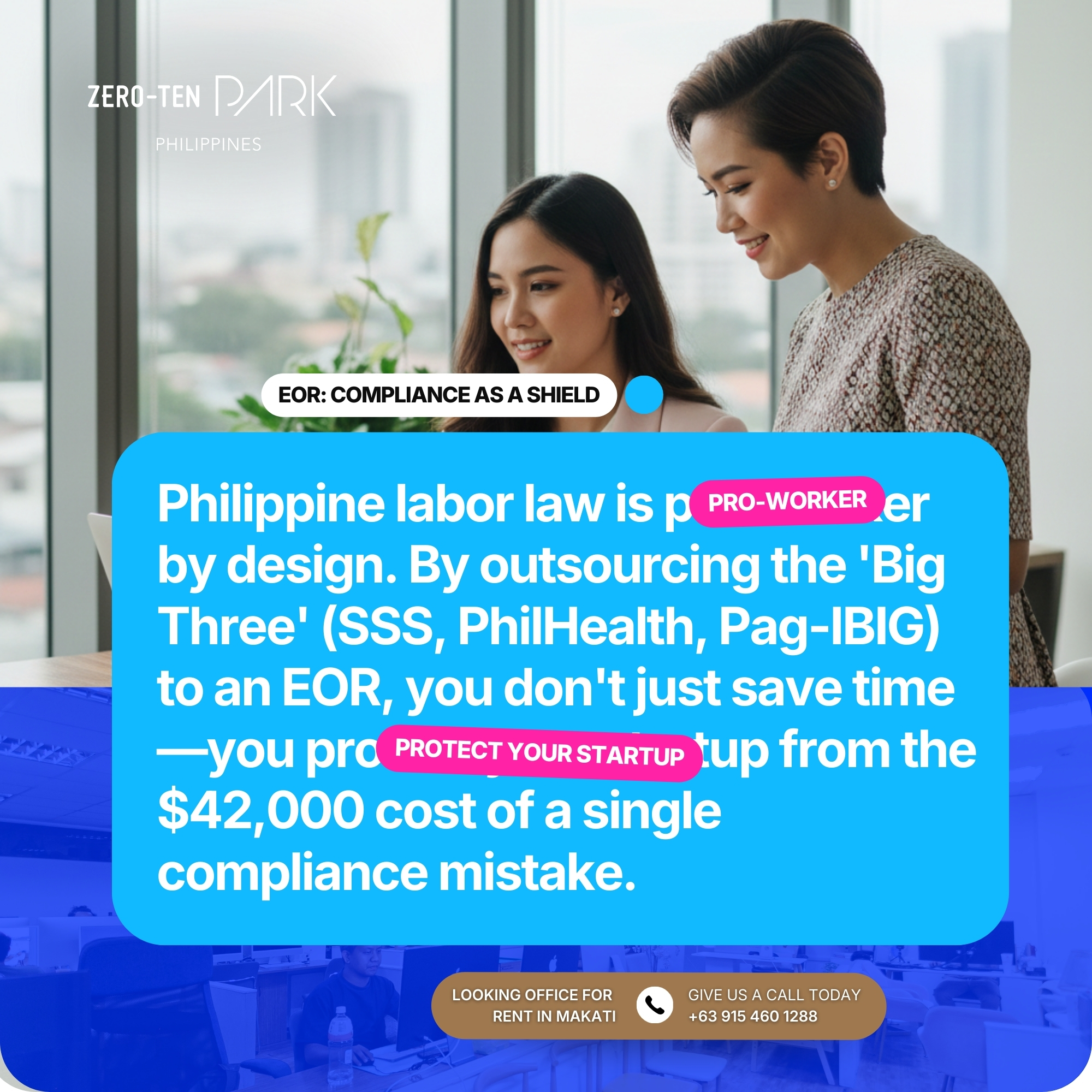
Philippine labor laws are notoriously pro-worker. Mistakes in how you draft a contract or handle a termination can lead to “Illegal Dismissal” cases that are costly and time-consuming.
An EOR acts as your compliance shield. They ensure that every contract includes the legally mandated 13th-month pay (a required bonus equal to one month’s salary) and proper contributions to the “Big Three” statutory funds:
- SSS (Social Security System): For retirement and disability.
- PhilHealth: National health insurance.
- Pag-IBIG: The home development mutual fund.
By outsourcing these liabilities, you protect your startup from the $42,000 USD average cost of a single international compliance incident.
3. Talent Retention through “Big-Company” Benefits
Top-tier Filipino talent—especially senior developers and executive assistants—is in high demand. If you hire them as independent contractors, you leave them to handle their own taxes and healthcare, which often leads to “churn” when a larger company offers them a full benefits package.
Why This Matters for Founders Today
Using an Employer of Record in the Philippines allows your small startup to offer the perks of a multinational corporation. EORs often have “group-buy” power, giving your two-person remote team access to premium HMOs (Private Health Insurance) and life insurance that you couldn’t secure on your own. In a culture where family welfare is the primary motivator, these benefits are your strongest tool for long-term retention.
NAVIGATING THE 2025 LANDSCAPE: REAL-WORLD IMPACTS ON YOUR TEAM
For a founder, scaling into a new territory requires more than just a recruitment strategy; it requires “situational awareness.” The Philippine labor market is not static. In 2025, several legislative and economic shifts have redefined how foreign startups must approach their remote operations to remain both competitive and compliant.
Before we dive in, let’s clarify some essential terminology that often confuses foreign founders:
- DOLE (Department of Labor and Employment): The primary government agency that creates and enforces labor laws. Think of them as the “referee” of the workplace.
- HMO (Health Maintenance Organization): Private health insurance. While the government provides basic coverage (PhilHealth), an HMO is a standard “top-tier” benefit that covers private hospital rooms and specialist consultations—critical for retaining talent.
- The Telecommuting Act (RA 11165): A law that governs work-from-home arrangements. Recent 2025 amendments now require more explicit documentation of “remote work allowances” (e.g., internet stipends).
Real-Event #1: The 2025 Minimum Wage Hikes
As of mid-2025, the National Capital Region (NCR) has seen a significant adjustment in the daily minimum wage, now reaching ₱695 for non-agricultural workers. While most startups pay well above this floor to attract high-level admin or backend talent, this hike acts as a “rising tide.”
Founder Insight: When the floor rises, the mid-level market follows. You should expect a ripple effect where senior talent expects a proportional 10–12% increase in their base offers to maintain their “premium” status over entry-level roles. This is where an Employer of Record in the Philippines becomes invaluable, as they automatically adjust your payroll to meet these new statutory floors without you needing to track regional board announcements.
Real-Event #2: The “Digital Cities 2025” Expansion
The government’s “Digital Cities 2025” initiative has successfully matured, pushing high-speed fiber infrastructure into provincial hubs like Iloilo, Bacolod, and Davao.
Founder Insight: You are no longer tethered to Manila-based talent. Hiring in “Next-Wave Cities” often allows you to secure highly loyal talent with a lower cost of living, meaning your USD or SGD offer goes much further. However, this geographic spread makes managing local taxes and “Barangay” (local district) clearances more complex—a task your EOR handles centrally.
Real-Event #3: New Digital Payslip and Compliance Rules
Effective March 2025, DOLE has mandated a transition to Digital Compliance Reporting. Companies are now required to issue digital payslips that clearly itemize every deduction, and non-compliance carries a 30% penalty of the total monthly payroll cost.
Founder Insight: Manual spreadsheets are now a liability. Because the Employer of Record in the Philippines already uses cloud-based HRIS (Human Resource Information Systems), they ensure your startup is “audit-proof” from day one. They provide your team with a portal where they can view their itemized SSS, PhilHealth, and Pag-IBIG contributions, fulfilling the law while building trust with your staff.
The Founder's Bottom Line
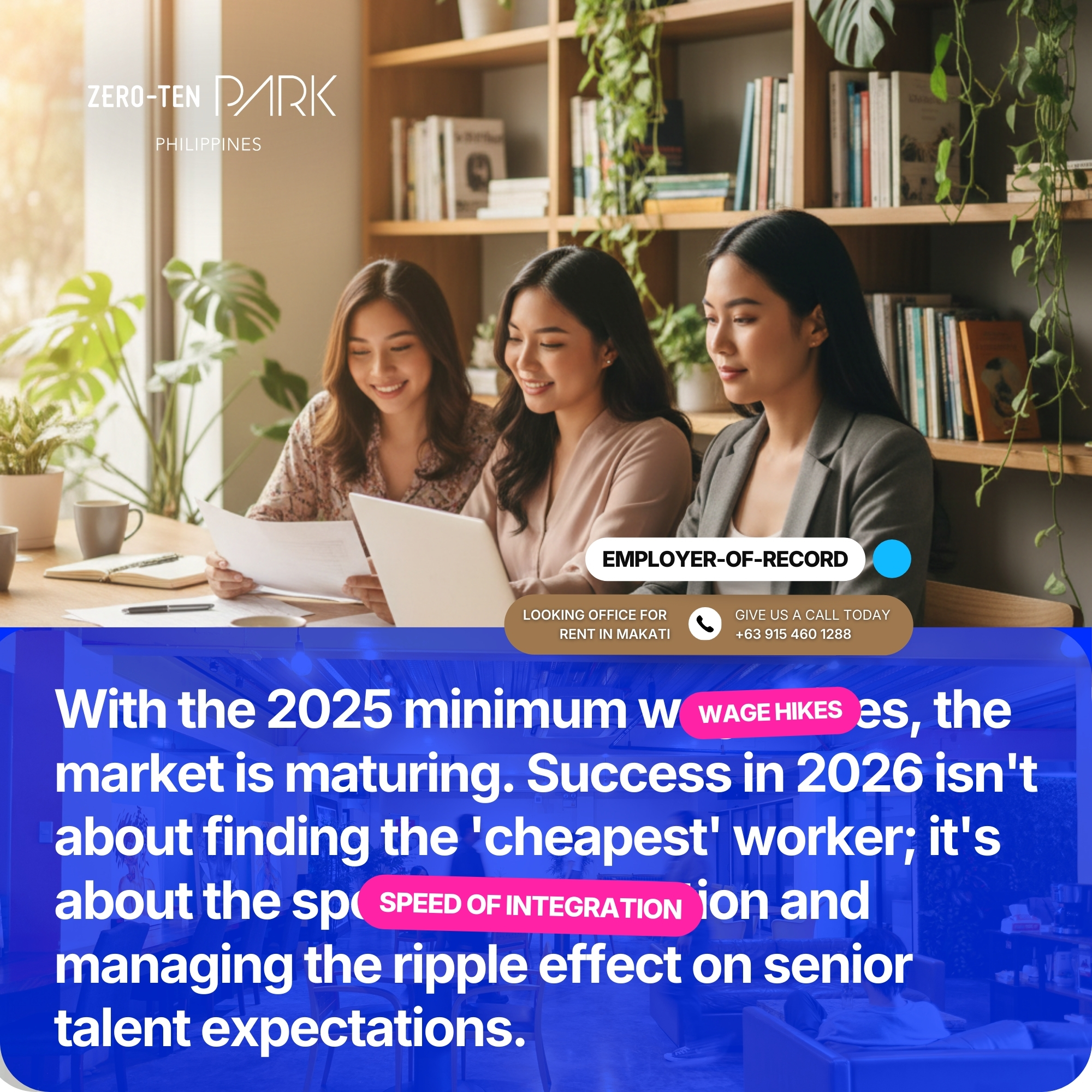
In 2026, the competitive advantage doesn’t come from finding the cheapest worker; it comes from the speed of integration. These events prove that the barrier to entry is no longer “finding talent”—it’s managing the increasingly complex legal and digital framework that talent lives within. An EOR allows you to “capture” the value of the Digital Cities expansion without being “captured” by the new 2025 compliance penalties.
THE "TWIN-NOTICE" RULE AND LEGAL RESILIENCE
In a startup, agility is everything. However, the biggest shock for many founders expanding into the Philippines is that “Employment at Will”—the standard in many US states where you can part ways with an employee for any reason at any time—does not exist here. In the Philippines, Security of Tenure is a constitutional right. This means once an employee is hired, they have a legal right to keep their job unless there is a specific, proven “Just” or “Authorized” cause to let them go.
Before we explore how to manage this, let’s define the critical legal terminology:
- Just Cause: Termination based on the employee’s fault (e.g., serious misconduct, fraud, or habitual neglect of duties).
- Authorized Cause: Termination based on business necessity (e.g., redundancy, retrenchment due to losses, or installing labor-saving devices).
- 13th-Month Pay: A mandatory statutory bonus. If you terminate an employee mid-year, you must pay them a “pro-rated” portion of this (e.g., if they worked 6 months, they get half a month’s salary as part of their final pay).
The Anatomy of the “Twin-Notice” Rule
If you need to terminate an employee for a Just Cause, the law requires a strict procedural dance known as the Twin-Notice Rule. Skipping any of these steps, even if the employee actually committed a violation, can result in an “Illegal Dismissal” ruling where you are forced to pay back-wages and damages.
- First Notice (Notice to Explain/NTE): You must give the employee a written notice specifying the grounds for termination. It cannot be vague; it must detail the “who, what, when, and where” of the violation.
- The 5-Day Rule: The law mandates that the employee be given at least five (5) calendar days from receipt of the notice to prepare and submit their explanation. You cannot rush this period.
- The Administrative Hearing: While not always mandatory, it is “best practice” to offer a hearing where the employee can present evidence or have a representative present. In 2025, these are commonly held via recorded Zoom sessions for remote teams.
- Second Notice (Notice of Decision): Only after considering the explanation can you issue the final notice. This notice must clearly state that all facts have been weighed and that the decision to terminate is final.
Why an EOR is Your Best Defense
Managing this process from a different time zone is a legal minefield. An Employer of Record in the Philippines takes this entire burden off your plate. Because they are the legal employer, their local HR experts and legal counsel draft the NTEs, moderate the administrative hearings, and ensure the second notice is served correctly.
This “Compliance-as-a-Service” means that if an employee ever files a complaint with the National Labor Relations Commission (NLRC), the EOR stands in the gap. For a startup founder, this isn’t just about saving admin time—it’s about ensuring that a single difficult termination doesn’t turn into a $10,000+ USD legal liability that distracts you from your product roadmap.
Authorized Causes: Redundancy and Separation Pay
- Sometimes, a startup needs to pivot, making a backend role redundant. This is an Authorized Cause. Unlike Just Cause, you don’t need a Twin-Notice procedure, but you do need:
- 30-Day Notice: Given to both the employee and the Department of Labor and Employment (DOLE).
- Separation Pay: For redundancy, the law usually requires one month’s pay for every year of service.
An EOR ensures these calculations are exact and that the DOLE filings are completed on time, protecting your company’s reputation and legal standing in the region.
THE CULTURAL BRIDGE: LEADING WITH "MALASAKIT" AND MANAGING "HIYA"
For a startup founder, the transition from a Western or high-efficiency business hub to the Philippine remote landscape is often more of a cultural shift than a logistical one. Success with a Philippine team isn’t just about the tools you use; it’s about understanding the “unwritten rules” of engagement. While your team will likely be highly fluent in English and technically proficient, their internal operating system is built on a “relationship-first” framework.
Before we explore management strategies, let’s define the cultural terminology that governs these interactions:
- Pakikisama (Harmony/Getting Along): The desire to maintain a smooth interpersonal relationship. It’s why a team member might avoid disagreeing with you in a group meeting—not because they don’t have an opinion, but because they don’t want to disrupt the group’s “vibe.”
- Hiya (Social Propriety/Shame): A deep sense of social dignity. It is the regulator that prevents a worker from admitting they are stuck on a task because they fear looking incompetent or “shaming” their team.
- Amor Propio (Self-Respect): A fragile sense of self-worth. If criticized harshly or publicly, a Filipino professional may feel a profound wound to their dignity, which can lead to immediate disengagement or resignation.
- Malasakit (Deep Care/Ownership): The “holy grail” of Filipino work ethics. It describes an employee who treats your startup as if it were their own, going far beyond their job description out of genuine loyalty.
Managing the “Yes” Culture
In many startup environments, “radical candor” is the gold standard. However, in the Philippines, direct confrontation is often seen as aggression. You may find that when you ask, “Can you finish this by Friday?”, the answer is always a polite “Yes,” even if the workload is impossible. This is Pakikisama in action—they are choosing harmony over a “difficult” truth.
Founder Insight: To get the truth, you must change how you ask. Instead of binary “Yes/No” questions, use Confidence Checks. Ask, “On a scale of 1 to 10, how confident are we that we can ship this by Friday without burning out?” If the answer is an “8,” it’s your cue to dig deeper in a private 1-on-1.
The Power of Private Feedback
Because of Hiya and Amor Propio, public correction is a “productivity killer.” If you point out a mistake in a shared Slack channel or during a group Zoom call, the employee may feel “shamed” in front of their peers. This often leads to “quiet quitting” or a sudden drop in communication.
Founder Insight: Always deliver critique in a 1-on-1 setting. Start by acknowledging their Malasakit (their effort and care) before addressing the error. When a team member feels their dignity is intact, their loyalty—and their willingness to fix the mistake—becomes unshakable.
Building Loyalty Through an EOR
While you manage the day-to-day “heart” of the team, your Employer of Record in the Philippines manages the “bones.” Cultural integration is easier when the administrative experience is seamless. By providing a professional, locally-compliant experience—complete with an HMO (Private Health Insurance) that covers their family—the EOR helps you demonstrate that you value them as more than just “low-cost labor.” In the Philippines, when you take care of an employee’s family, they respond with a level of loyalty and ownership that is rare in the global freelance market.
THE FOUNDER'S 90-DAY CHECKLIST
To wrap up your expansion, use this checklist to ensure no legal or cultural stone is left unturned.
Month 1: Legal & Technical Setup
- [ ] Contract Verification: Ensure the EOR contract explicitly states the 6-month probationary period and “Just Causes” for termination.
- [ ] Statutory Enrollment: Confirm the employee is registered with SSS, PhilHealth, and Pag-IBIG under the 2025 updated rates.
- [ ] Hardware Audit: Verify the team has a noise-canceling headset, a 1080p webcam, and a backup internet source.
- [ ] 13th-Month Accrual: Set aside 1/12th of the monthly salary starting from Month 1 to avoid a cash-flow shock in December.
Month 2: Cultural Integration
- [ ] Feedback Loop: Establish a private 1-on-1 schedule to navigate Hiya (shame) and encourage open communication.
- [ ] Standard Communication: Distribute a “Remote Work Handbook” detailing your specific time-zone overlap expectations.
- [ ] Malasakit Recognition: Publicly praise a “win” in the team channel to build confidence, while keeping critiques strictly private.
Month 3: Performance & Future-Proofing
- [ ] 90-Day Review: Conduct a formal evaluation. If performance is lacking, issue a formal “Improvement Plan” to satisfy Philippine Due Process requirements.
- [ ] HMO Check-in: Ensure the employee and their dependents have received their physical or digital health cards.
- [ ] Data Privacy Audit: Ensure the team is using the required VPNs or secure portals as mandated by your EOR’s compliance guidelines.
Building a Philippine team is a marathon, not a sprint. By following these steps and leveraging an Employer of Record in the Philippines, you are building a resilient, compliant, and high-performing engine that allows your startup to compete on a global scale.
THE PHILIPPINE EOR DECISION MATRIX
Choosing an EOR is the most important administrative decision you will make as you scale. In 2025, the market has bifurcated into Global SaaS Platforms (best for tech and multi-country speed) and Local Specialists (best for deep in-country compliance and cost-efficiency).
To help you decide, I have built this decision matrix based on current 2025 market data and the specific logic of the Philippine labor market.
| Criteria | Global SaaS Platforms (e.g., Deel, Remote, Rippling) | Local/Regional Specialists (e.g., Zero-Ten Park Philippines, Smart Outsourcing Solution (SOS), Remotify.ph, RecruitGo) |
| Pricing (Monthly Fee) | High: $500 – $700+ USD per employee. | Competitive: $190 – $350 USD per employee. |
| Best For | Startups scaling in 3+ countries simultaneously. | Startups focusing purely on the Philippines. |
| Onboarding Speed | Fast: Fully automated, often 2–5 days. | Varies: 2–10 days (often involves more “human” touchpoints). |
| Local Support | Tiered: Support is often via ticket or global call centers. | High-Touch: Direct access to Filipino HR experts and account managers. |
| Crypto/Web3 | Strong: Direct stablecoin/crypto payouts (e.g., Deel, Rise). | Limited: Mostly traditional bank transfers (PHP/USD). |
| Compliance Depth | Standardized: Uses broad templates for 100+ countries. | Surgical: Deeply aligned with DOLE D.O. 174-17 and local tax nuances. |
| Retention Perks | Marketplace: Offers generic international benefits. | Localized: Direct relationships with top local HMOs (Maxicare/Intellicare). |
Choose Your Path: A Logic-Based Selection
1. Choose a Global SaaS Platform if…
- You are a VC-backed startup with a “growth at all costs” mandate and need to hire in the Philippines, Vietnam, and Poland all this month.
- You want one “Source of Truth” for all your global HR data and integrations with tools like Slack, Jira, or BambooHR.
- You need “One-Click” contractor-to-employee conversion.
- Key Players: Deel (Best for UX), Remote (Best for IP protection), Rippling (Best for IT/Device management).
2. Choose a Local Specialist if…
- You are “Bootstrapped” or ROI-focused. Paying $600/month in EOR fees for a $1,000/month admin assistant kills your margins. A specialist like SOS at $190/month makes more sense.
- You value “Human” HR. You want someone to actually call your employee if there’s a family emergency or a performance issue, rather than just sending an automated email.
- You need physical office space. Many local providers (like KMC Solutions or RecruitGo) offer “Seat Leasing” or hybrid office options in Manila/Cebu, which global SaaS companies do not.
- Key Players: Smart Outsourcing Solution (Best for low flat fees), Remotify.ph (Best for founder-led startups), RecruitGo (Best for deep regional knowledge).
3 Critical “Founder Questions” for Your Sales Call
Before signing a contract with an Employer of Record in the Philippines, ask these three questions to flush out hidden costs:
- “Is your entity a ‘Direct’ or ‘Partner’ model?”
- Logic: Direct EORs own their local Philippine entity. Partner-based EORs outsource to a local third party. Direct is always safer for IP protection and faster support.
- “Are there markups on Mandatory Benefits?”
- Logic: Some EORs quote a low base fee but then “upcharge” the cost of SSS and PhilHealth. Ensure you are only paying the actual statutory cost plus the flat EOR fee.
- “How do you handle the 13th-month pay accrual?”
- Logic: Some EORs bill you for 13th-month pay in 12 monthly installments (accrual), while others send one massive bill in December. Choose the one that matches your startup’s cash flow.
Building a remote team in the Philippines is a high-leverage move for any startup founder. If you navigate the first 90 days correctly using the logic we’ve discussed, you aren’t just cutting costs; you are building a resilient, 24/7 engine for your business.
ENDGAME STRATEGY FOR EXPLOSIVE GROWTH AND PROVIDER FAILURE
To wrap up this guide, here is your “Endgame Strategy” for two critical scenarios: explosive growth and provider failure.
1. What to do if your remote team grows quickly
As a founder, “too much growth” is a good problem to have, but it can quickly outpace an EOR’s manual processes. If you find your team expanding from 5 to 50+ members in a single year, you must shift your strategy.
- Audit Your Unit Costs: EORs charge per-head fees. When you reach 25–40 employees, the total annual service fees often exceed the cost of hiring a local HR manager and an accountant. This is the “Pivot Point.”
- The “Build-Operate-Transfer” (BOT) Model: Ask your EOR if they support a “Transfer” clause. This allows you to eventually incorporate your own local entity and “migrate” the employees from the EOR’s payroll to yours without disrupting their tenure or benefits.
- Layer Local Leadership: Once you hit 10 members, you can no longer manage every 1-on-1 from New York or Singapore. Hire a “Country Operations Manager” in the Philippines. This person will act as your “boots on the ground,” managing the EOR relationship and ensuring local culture remains aligned with your startup’s mission.
2. What to do if your EOR provider messes up
Despite being “compliance shields,” EORs can make mistakes—missed tax filings, delayed SSS contributions, or incorrect 13th-month calculations. In the Philippines, the government (and the NLRC) ultimately protects the worker, and a provider’s mistake can damage your “Employer Brand.”
- The “Quarterly Compliance Audit”: Never assume the EOR is 100% compliant. Every quarter, ask for the “Proof of Remittance” for SSS, PhilHealth, and Pag-IBIG. Most EORs have a dashboard, but you should verify that the name of each employee matches the government receipt.
- Immediate Damage Control: If a payroll error occurs (e.g., an employee is underpaid), instruct the EOR to issue a manual check/transfer immediately. Do not wait for the next “pay cycle.” In Filipino culture, trust is tied to the reliability of support for their family; a delayed payment is a major breach of that trust.
- Invoke the Indemnification Clause: Your EOR contract should have an Indemnification Clause. If they miss a filing and the government imposes a penalty, the EOR—not your startup—must legally and financially carry that burden.
- Have a “Switch” Plan: If errors become habitual (more than twice a year), it is time to move. Modern platforms like Deel or Remote make it relatively easy to “offboard” and “onboard” to a new provider. Because the employee’s functional work (Slack, Trello, Zoom) doesn’t change, a provider swap is mostly a “paperwork event” that shouldn’t stop your operations.
Request for Proposal (RFP): Employer of Record Services Template
To secure the right partner, you need to shift from being a “consumer” to being a “client.” Sending a structured Request for Proposal (RFP) forces EOR providers to move past their marketing slides and give you hard data on their compliance, response times, and pricing.
The following template is designed for a lean startup. It focuses on transparency, speed, and cultural alignment, ensuring you can compare multiple providers side-by-side using the decision matrix we discussed earlier.
Request for Proposal (RFP): Employer of Record Services (Philippines)
To: Prospective EOR Service Provider
From: [Your Startup Name]
Date: [Current Date]
Subject: Proposal for Employer of Record (EOR) and Payroll Services in the Philippines
1. Executive Summary & Startup Context
[Your Startup Name] is a [Industry, e.g., Fintech/SaaS] startup based in [City/Country]. We are looking to hire a team of [Number, e.g., 3–5] remote professionals in the Philippines for [Roles, e.g., Customer Support and Backend Admin]. We require a partner who can act as the Employer of Record in the Philippines, managing all local legalities while we focus on day-to-day operations.
2. Scope of Services Required
Please confirm your ability to provide the following:
- Compliant Onboarding: Drafting of localized employment contracts including IP protection and 6-month probationary clauses.
- Payroll & Statutory Remittance: Accurate monthly payroll in PHP, including the calculation and timely remittance of SSS (at the 2025 15% rate), PhilHealth, and Pag-IBIG.
- 13th-Month Pay Management: Automated accrual and distribution of mandatory 13th-month pay.
- Benefits Administration: Provision of a Private Health Insurance (HMO) plan for employees.
- Termination Support: Guidance and legal execution of the “Twin-Notice Rule” if necessary.
3. Technical & Operational Questions
Please provide brief responses to the following:
- Direct vs. Partner Model: Do you own your legal entity in the Philippines, or do you use a third-party partner?
- SLA (Service Level Agreement): What is your guaranteed response time for HR or payroll inquiries from (a) the Founder and (b) the Employee?
- Onboarding Timeline: From the moment we select a candidate, how many business days does it take to get them “Live” and on payroll?
- Data Privacy: How do you ensure compliance with the Philippine Data Privacy Act of 2012 for remote employee data?
4. Pricing Structure
Please provide a fully itemized quote using the following format:
- Monthly Management Fee: [Flat fee per employee or % of payroll]
- One-time Onboarding/Setup Fee: [If applicable]
- Estimated Employer Burden: [Approximate % on top of base salary for SSS, PhilHealth, Pag-IBIG, etc.]
- Termination/Offboarding Fees: [Specify if any]
5. Submission Instructions
Please submit your proposal in PDF format to [Your Email Address] by [Deadline Date]. We will select a shortlist for a 20-minute video interview by [Interview Date].
Why this RFP works for a Founder:
- Standardization: You get every provider to answer the “Direct vs. Partner” question, which is the #1 indicator of service quality.
- Cost Control: By asking for the “Estimated Employer Burden,” you can accurately project your burn rate before you make your first hire.
- Accountability: Mentioning the “2025 SSS rate” (15%) shows the EOR that you are an informed founder who cannot be easily misled by outdated compliance data.
The following EOR Provider Scorecard uses a weighted scoring system. Not all criteria are equal—for a startup, Local Compliance and Cost usually carry the most weight, while “Brand Recognition” is secondary.
EOR Provider Selection Scorecard
Instructions: Rate each provider on a scale of 1 to 5 for each category. Multiply the “Score” by the “Weight” to get the Weighted Total. The provider with the highest total is your primary candidate.
| Evaluation Category | Weight | Provider A | Provider B | Provider C |
| Local Entity Ownership (Direct vs. Partner model) | 25% | |||
| Cost Transparency (Admin fee + Statutory accuracy) | 20% | |||
| Response Time (SLA) (Speed of support for you/team) | 15% | |||
| Benefit Quality (HMO tiers and family coverage) | 15% | |||
| Tech Usability (Onboarding & Payroll dashboard) | 15% | |||
| Termination Expertise (Proven “Twin-Notice” workflow) | 10% | |||
| TOTAL SCORE | 100% | 0.0 | 0.0 | 0.0 |
How to Grade the “Red Flags” (The “Auto-Fail” Rules)
When reviewing your RFP responses, if a provider hits any of these “Red Flags,” give them a 0 in that category, or disqualify them entirely:
- The “Contractor-Only” Trap: If they suggest hiring your full-time, dedicated admin staff as “Independent Contractors” to save money, disqualify them. This exposes you to massive misclassification risk in the Philippines.
- Vague Benefit Markups: If they cannot give you the exact premium for a Maxicare or Philam health plan and instead say “it depends,” they are likely hiding a 10–20% markup on the insurance.
- No Philippine Office: If the EOR doesn’t have a physical presence or a dedicated Philippine support team (e.g., they support you from a call center in a different time zone), your employees will feel the “disconnect” during payroll issues.
✨ ZERO-TEN PARK PHILIPPINES: YOUR EOR IN THE PHILIPPINES
At Zero-Ten Park, we specialize in providing a “soft landing” for founders scaling in the Philippines. Beyond our premium workspace in Makati, our integrated Employer of Record in the Philippines service removes the bureaucratic friction of international expansion, allowing you to hire and onboard local talent in a matter of days. We handle the complexities of Labor Code compliance, 13th-month pay, and 2026 statutory contributions so you can focus on moving your business from zero to ten.
FREQUENTLY ASKED QUESTIONS
Yes. Under the Employer of Record (EOR) model, you are using a legally registered Philippine organization to act as the employer on paper. This is a recognized and common business practice in the Philippines. The EOR assumes all responsibilities for the Labor Code, taxes, and statutory contributions, while you retain the right to manage the employee’s daily tasks and performance.
It is a legal requirement, not a performance-based bonus. Under Presidential Decree No. 851, all rank-and-file employees who have worked for at least one month are entitled to this payment. It must be paid no later than December 24th and is equivalent to 1/12 of the employee’s total basic salary earned within the calendar year. Most EORs will help you accrue this monthly so you aren’t hit with a large cash-flow requirement at the end of the year.
No. Professional EOR providers use “tri-party” or “flow-through” agreements. These contracts explicitly state that while the EOR is the legal employer for payroll and tax purposes, all work product, code, and inventions created by the employee are the exclusive property of your startup. However, always verify that your EOR contract has a strong IP Assignment clause that aligns with the laws of your home jurisdiction (e.g., NY, AU, or SG).
As of 2026, the combined SSS contribution rate has reached 15% (split between employer and employee), with a higher Monthly Salary Credit (MSC) cap of ₱35,000. While the EOR manages the actual filing, you should budget for a slightly higher “employer burden” than in previous years. Your EOR should provide a transparent breakdown showing that they are remitting these exact amounts to the government on your behalf.
Yes, but you must follow “Due Process.” Unlike “at-will” jurisdictions, the Philippines requires a “Just Cause” for termination. You cannot fire someone instantly for poor performance without documentation. You must follow the Twin-Notice Rule: (1) a notice to explain the violation, followed by a hearing/explanation period, and (2) a final notice of decision. Your EOR will act as your legal counsel and HR lead to ensure this process is followed perfectly to avoid “Illegal Dismissal” lawsuits.

GET A QUOTE TODAY
"*" indicates required fields
Ready to level up your business presence and save more every month? Complete the form now and our team will handle the rest.